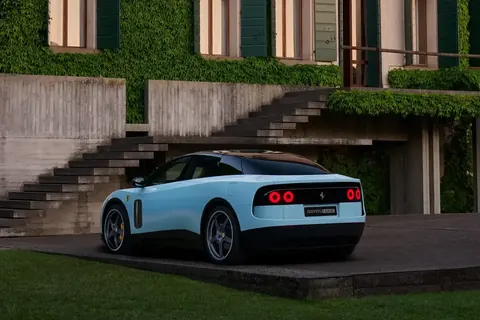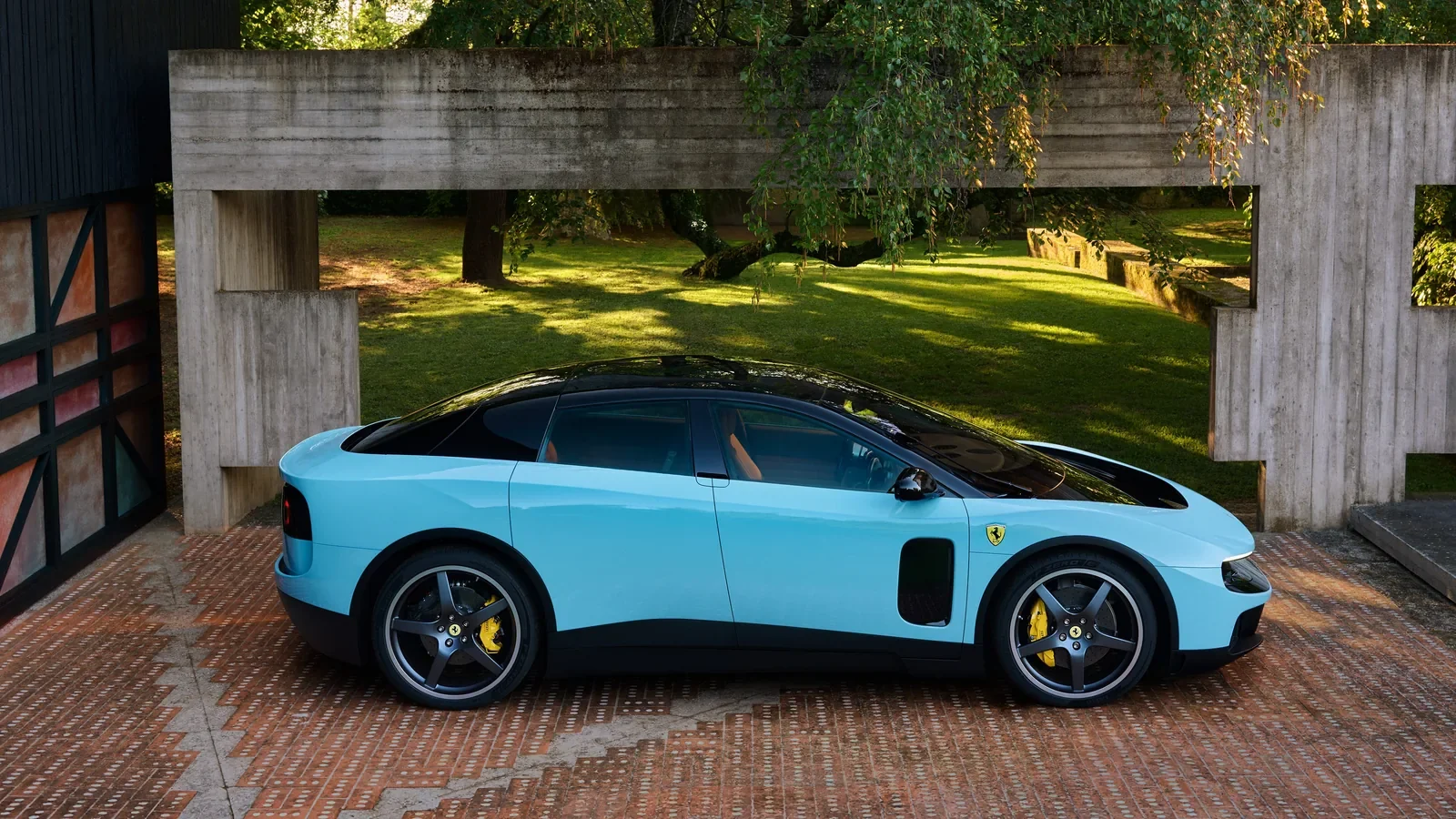
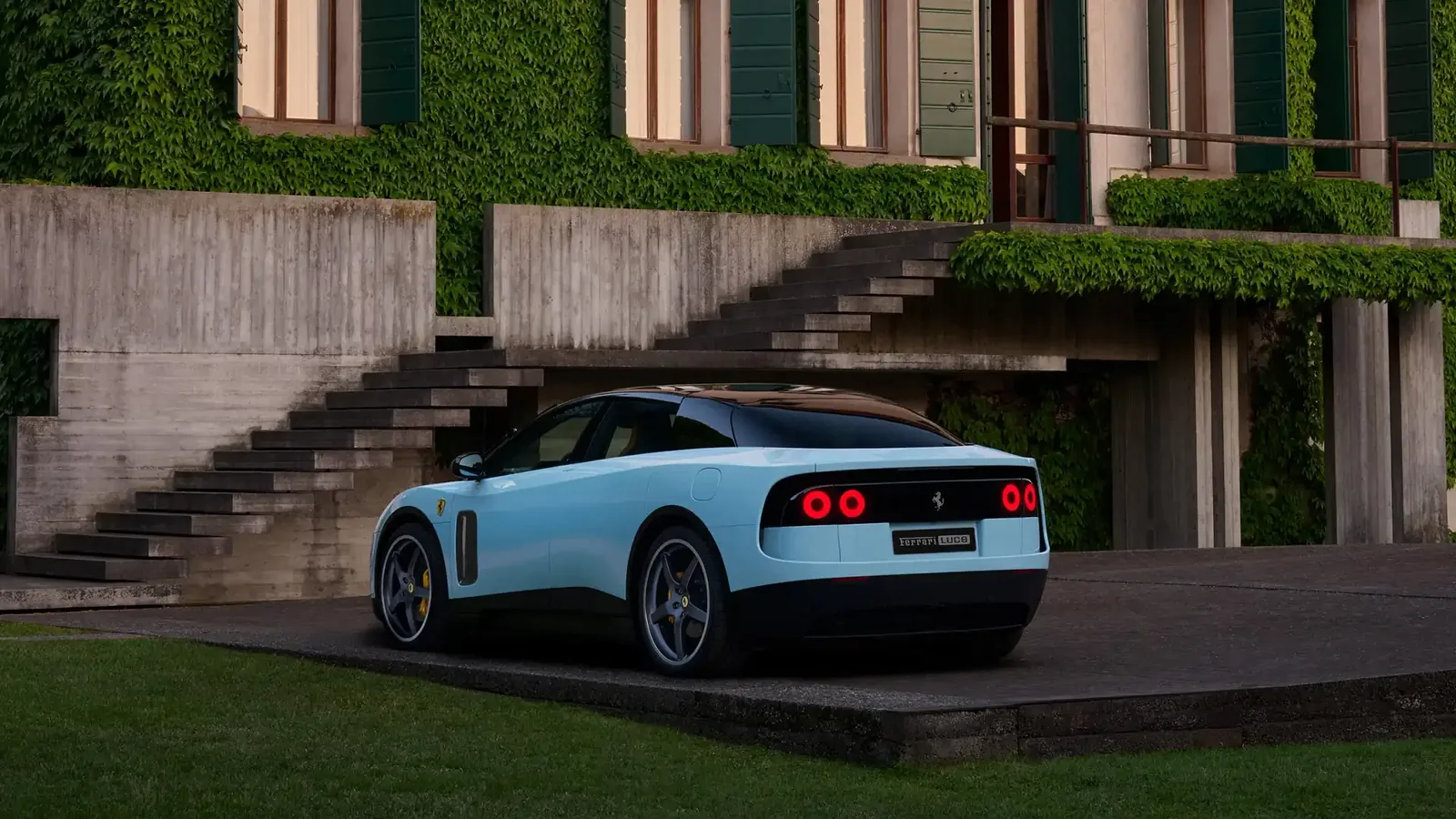
Ferrari showed the finished Luce at the Vela di Calatrava in Rome on 25 May 2026. It is the first fully electric Ferrari, the first five-seater the company has ever built, and the second five-door after the Purosangue. Official peak output is 1,050 cv (772 kW / 1,036 hp) from four motors, the pack is 800 volts — not 880 — and the European list price is €550,000. We first covered the car on 20 April 2026, before the exterior was public; this is the same URL, rewritten against the factory numbers.
Ferrari Luce Price
Ferrari's European list price is €550,000 before Tailor Made. Autocar has estimated a UK figure around £440,000, plus or minus 10 percent; that remains an estimate, not a published list. Ferrari has not published a US MSRP. China launch pricing, reported at the 27 June 2026 event, was 3,988,000 yuan. Full technical data sits in the specification table.
A one-off Tailor Made Chassis 0 crossed the block at RM Sotheby's Monterey for $40,000,000, with the proceeds directed to the Ferrari Foundation. That is a charity commission, not a production price, and it should not be read as a market for the series car.
Five Doors, Five Seats, Cab-Forward
Luce is Italian for "light." The internal type number is F222; the project ran as Elettrica until the San Francisco interior show in February 2026. The body is a five-door liftback with coach, aft-hinged rear doors and a cab-forward greenhouse. Exterior and interior were designed with LoveFrom — Sir Jony Ive and Marc Newson — working with Ferrari Design under Flavio Manzoni.
Ferrari publishes 5,026 mm long, 1,999 mm wide, 1,544 mm high, on a 2,961 mm wheelbase. That is 53 mm longer and 45 mm lower than Purosangue. Kerb weight is 2,260 kg, distribution 47:53, centre of gravity 95 mm lower than the SUV. The boot is 597 litres; the rear bench splits 40/20/40.
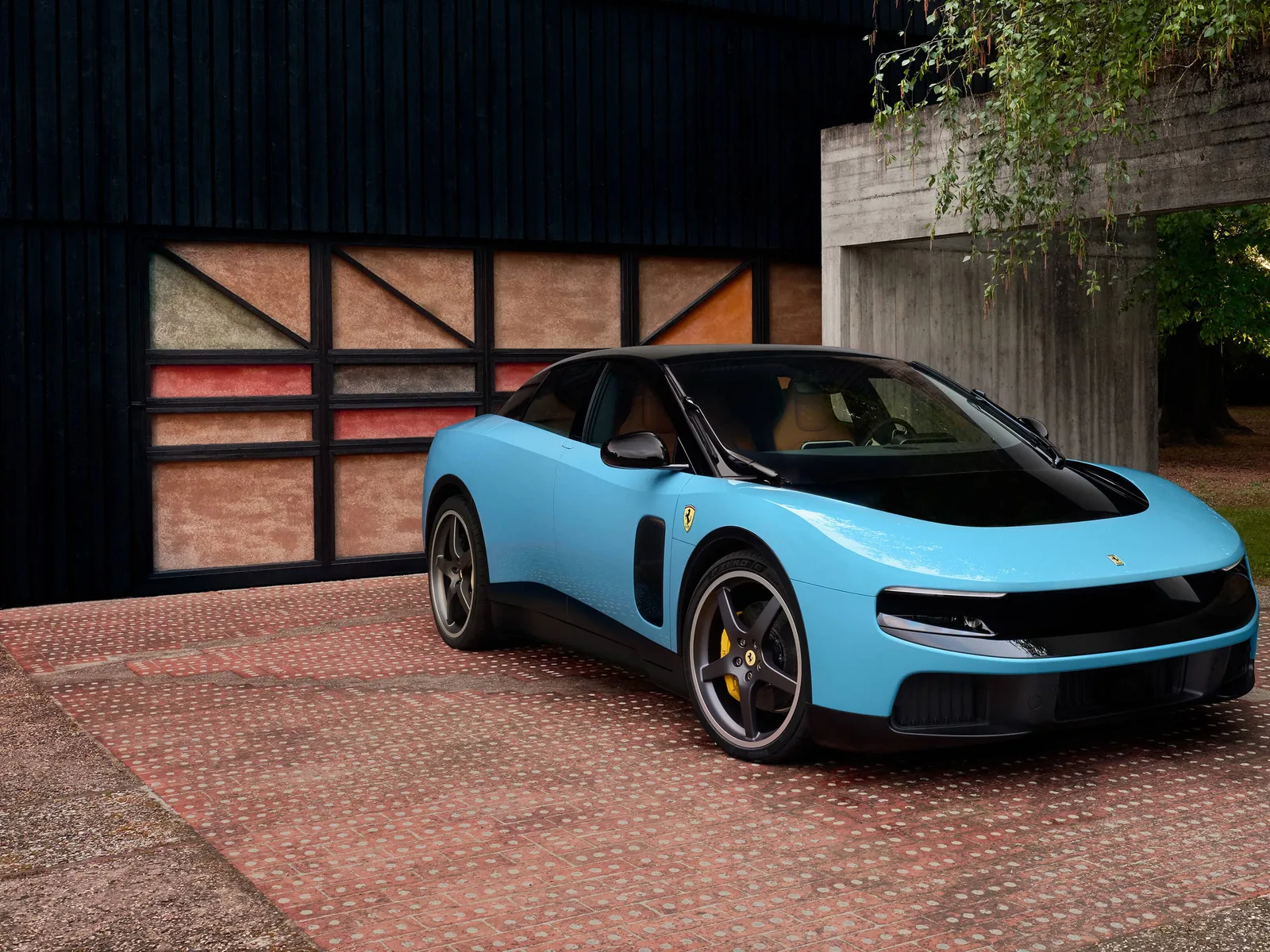
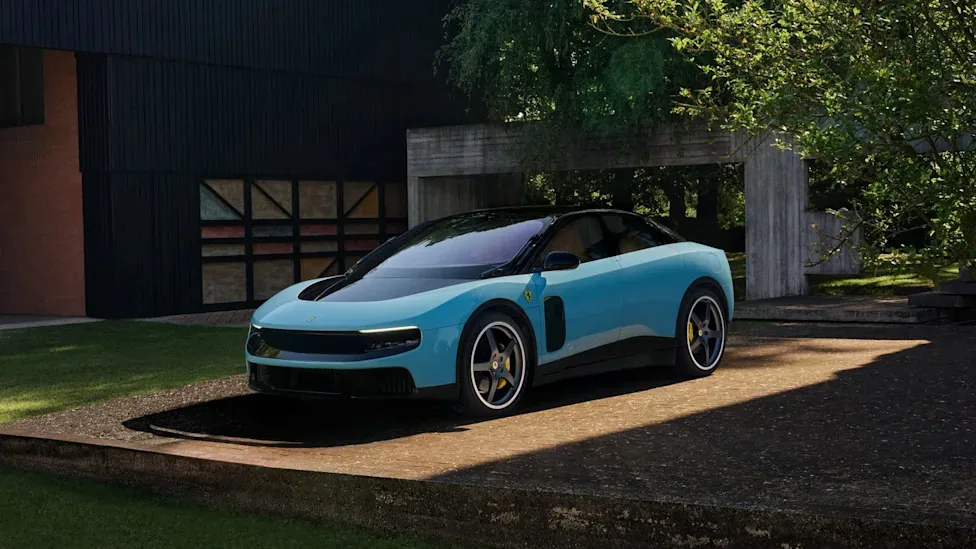
The wheels are the largest Ferrari has fitted to a production car: 23 × 9.5J front and 24 × 11J rear, in two styles, with Pirelli, Michelin or Bridgestone rubber. Carbon-ceramic discs measure 390 mm at the front and 372 mm at the rear.
1,050 cv — Four Motors, One System Peak
Four radial-flux permanent-magnet synchronous motors, one at each wheel, were developed in-house at Maranello. The front axle is rated at 210 kW (105 kW / 141 hp and 140 Nm each, to 30,000 rpm). The rear axle is rated at 620 kW (310 kW / 416 hp and 355 Nm each, to 25,000 rpm). Those axle figures do not add to the car's headline: Ferrari's system peak is 772 kW / 1,050 cv. Earlier "1,000+" and "up to 1,113 hp" estimates are retired.
Motor torque is about 990 Nm (739 lb-ft). At the wheels Ferrari quotes 7,750 Nm — not the old 8,000 Nm rear / 3,500 Nm front split that circulated before Rome. CAR magazine's instrumented mode breakdown is useful as a map of what the eManettino actually does: Range at 429 bhp with the front motors disconnected; Tour at 617 bhp and 193 mph; Performance at 972 bhp; launch control at 1,035 bhp. Those are CAR's figures, not a second factory peak.
Claimed performance: 0–100 km/h in 2.5 seconds, 0–200 km/h in 6.8 seconds, top speed 310 km/h (Autocar: 192 mph).
800-Volt Pack, 530 km WLTP
The architecture is 800 volts. Pre-reveal copy that called it 880 V was wrong. The structural floor pack is 122 kWh gross, about 111 kWh usable: 210 SK On NMC pouch cells, 14 per module across 15 modules, 630 kg, assembled in Maranello. Peak discharge is 830 kW. DC charging peaks at 350 kW; Ferrari says 70 kWh in 20 minutes, which is closer to 210 kW sustained than to the headline peak.
Ferrari's homologation figure is 530 km WLTP (329 miles as a straight conversion). Electrive has noted that homologation was still marked preliminary at launch. Ferrari has not published an EPA range, and we will not invent one.
Interior by LoveFrom: Buttons, Not a Tablet
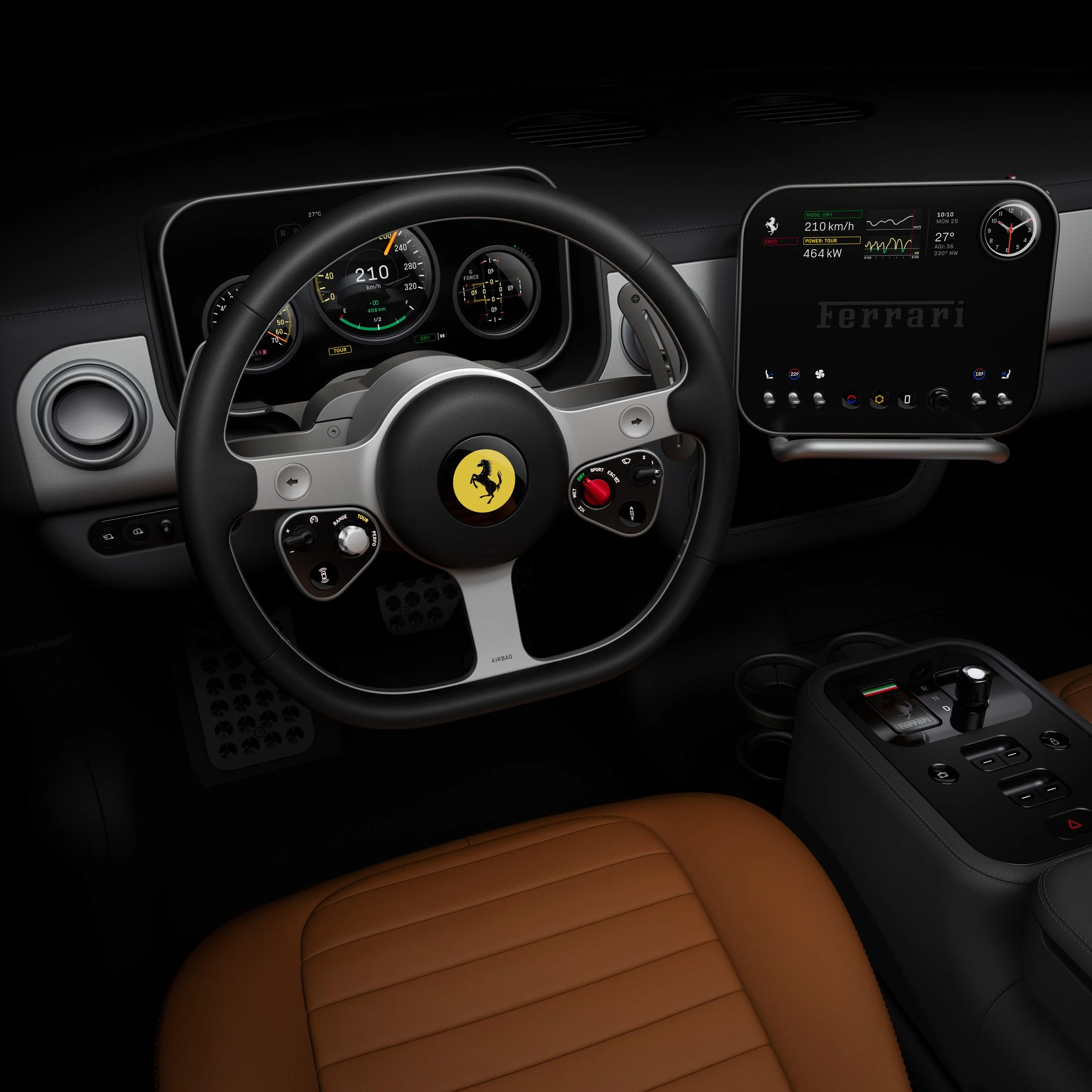
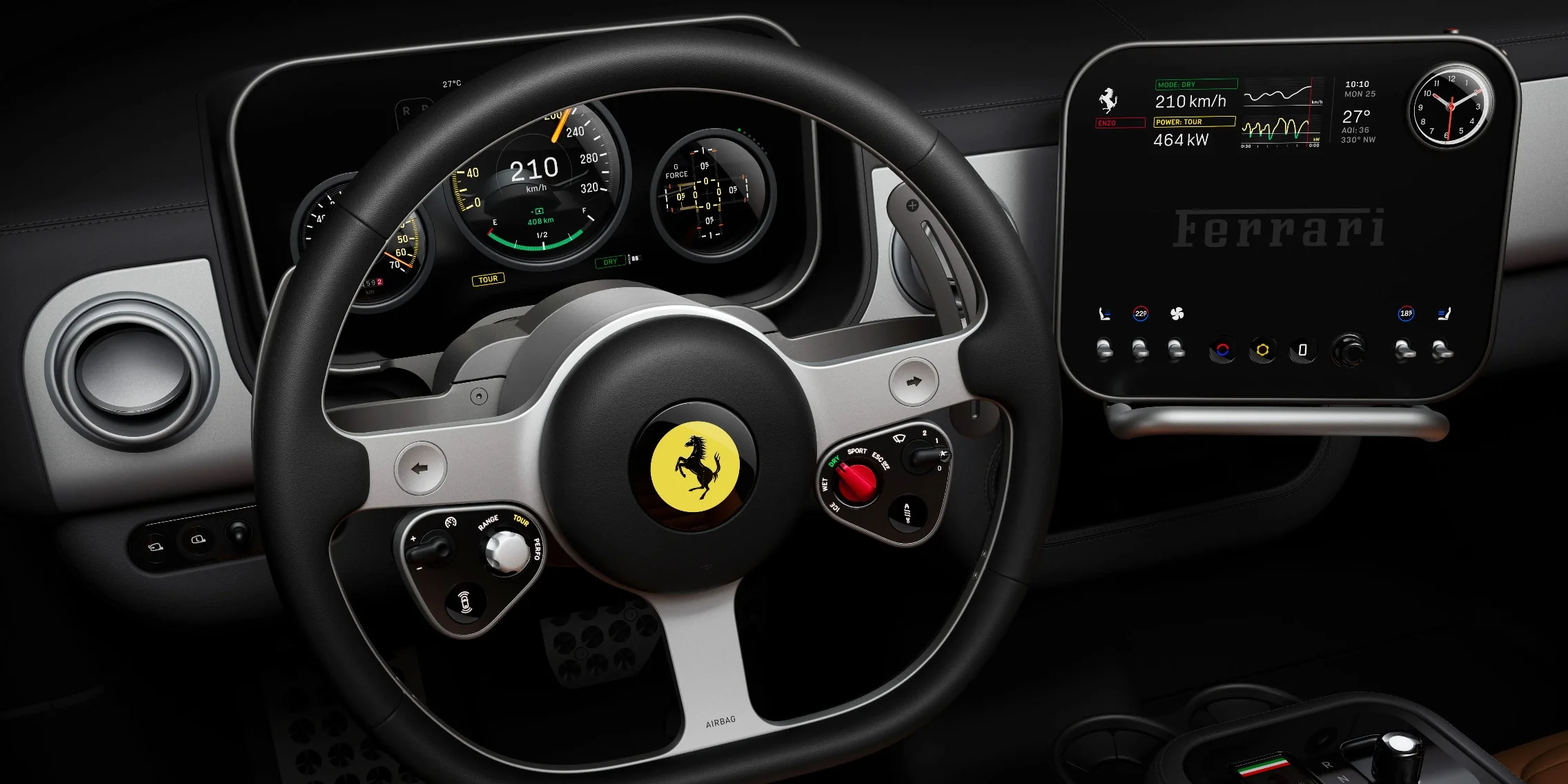
The cabin is the part almost every outlet praised, including those that disliked the body. Ive — the designer who spent two decades removing buttons from consumer electronics — specified a cockpit that puts them back. The three-spoke wheel is 100 percent recycled aluminium in 19 CNC-machined pieces. The right spoke carries the traditional Manettino. The left carries the eManettino for Range, Tour and Performance. The paddles are not fake gears: the right paddle steps through torque slices, the left sets regenerative braking.
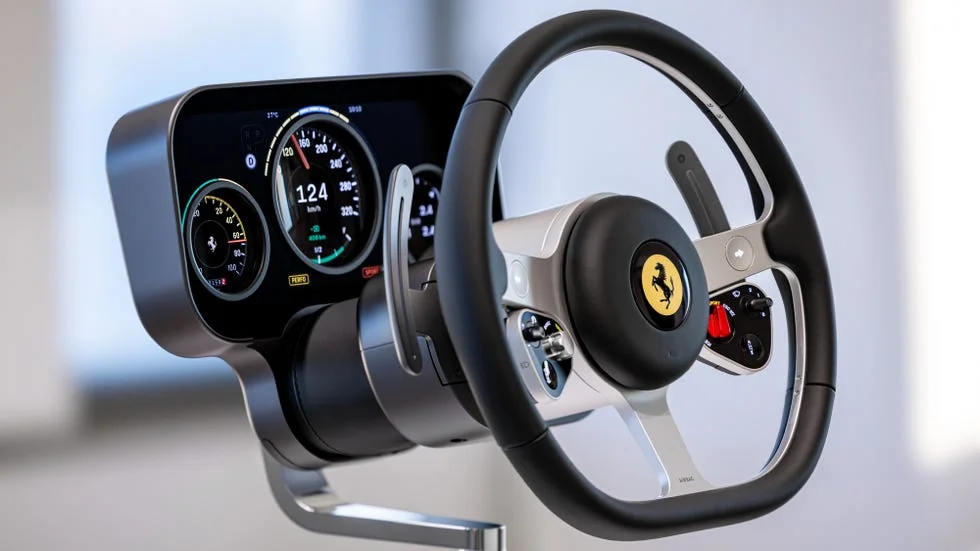
The centre console is Corning glass, hardened in a salt bath and laser-drilled. The driver's glass key seats in the console. A 10.12-inch central screen sits on a ball joint. The binnacle is a Samsung OLED stack with physical needles. Launch control is a helicopter-style overhead lever. The audio system is 21 speakers and 3,000 W.
The Sound Is the Rear Axle, Not a Fake V12
Ferrari refused a synthesised engine note. Sound engineer Antonio Palermo takes an accelerometer on the rear axle, filters gear whine, and amplifies what remains through the cabin — the same method as a guitar pickup and amp. The driver can hear left-to-right torque split. There is no recorded V12 underneath it.
Chassis: Every Wheel, Independently
The Luce uses Ferrari's Gen 3 active suspension — the Purosangue and F80 family — on a 48-volt circuit with motor-driven recirculating-ball screws, fast enough that anti-roll bars are deleted. Four-wheel steering and per-wheel torque vectoring sit on one computer. Drive modes run from Ice to ESC-Off. At 2,260 kg it is still a heavy Ferrari; Maranello's claim is that the mass sits low enough, and the actuators fast enough, that it should not drive like 2,260 kg.
Allocation, China, and What Ferrari Will Not Say
European deliveries are scheduled for Q4 2026, the United States for Q2 2027. The Financial Times, citing unnamed sources, reported that the 2026 run is fewer than 500 cars and was allocated within two months of Rome. A longer-term figure of about 2,500 through 2030 has circulated the same way. Ferrari has not published official regional volumes.
Early China coverage that "88 cars sold out" was later clarified by CarNewsChina as dealer-quota reporting, not confirmed retail contracts. Treat it as that. CEO Benedetto Vigna's line at launch still stands: this is an addition to the range, not a transition. The 2030 mix Ferrari has described is 20 percent electric, 40 percent hybrid, 40 percent combustion — the same strategy that put a gated six-speed in the 12Cilindri.
The Design Argument Is a Separate Story
Ferrari called the shape "polarising" in its own press material. Shares fell about 8.4 percent the next session, then recovered. Luca di Montezemolo was publicly critical. The 2026 allocation still filled. The design backlash — and the parallel argument around the Mercedes-AMG GT 4-Door EV — is covered at length in our Luce vs AMG GT design piece. This page is the car: price, motors, pack, seats.
Ferrari Luce Full Specification Table
The Verdict
The Luce is not a compliance car and it is not a 1,113-horsepower rumour. It is a 1,050 cv, rear-biased, five-seat GT with an 800-volt floor, coach doors, and a cabin that treats haptic controls as the Ferrari part of the brief. Whether the body is accepted is a different argument — already written. Whether it drives like a Ferrari will be answered by the first customer cars in Q4, not by another render.
Sources & Verification
Official figures taken from Ferrari's Rome materials as reported by Autocar (25 May 2026), Car and Driver and Reuters; architecture and charging notes cross-checked with electrive. European price and five-seat packaging: Bloomberg. China quota clarification: CarNewsChina, 30 July 2026. Chassis 0 hammer price: RM Sotheby's Monterey. 2026 volume reporting via the Financial Times, unnamed sources — not a Ferrari publication. eManettino mode powers as published by CAR magazine, labelled as such. Performance and range figures are manufacturer-quoted unless noted.