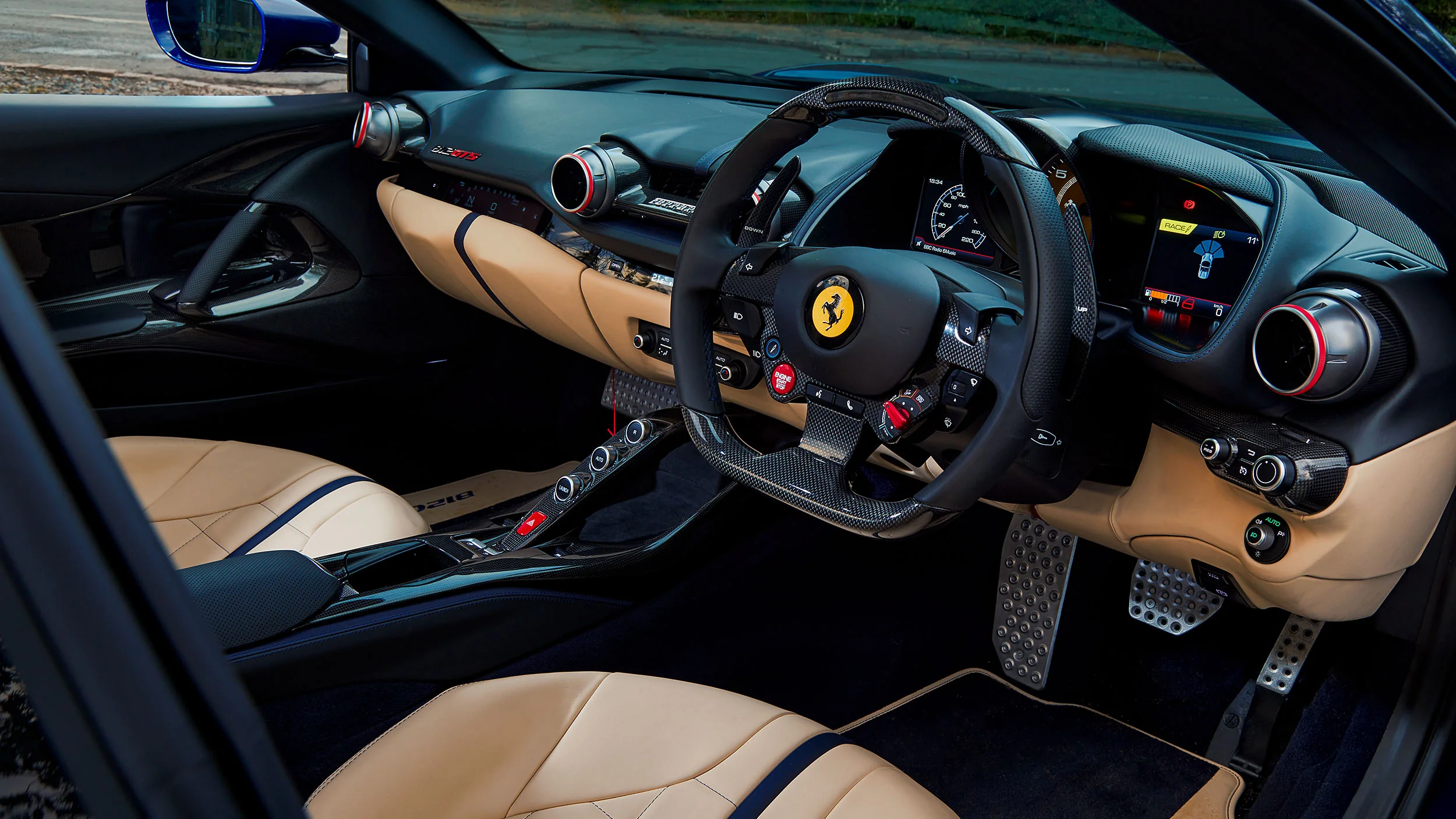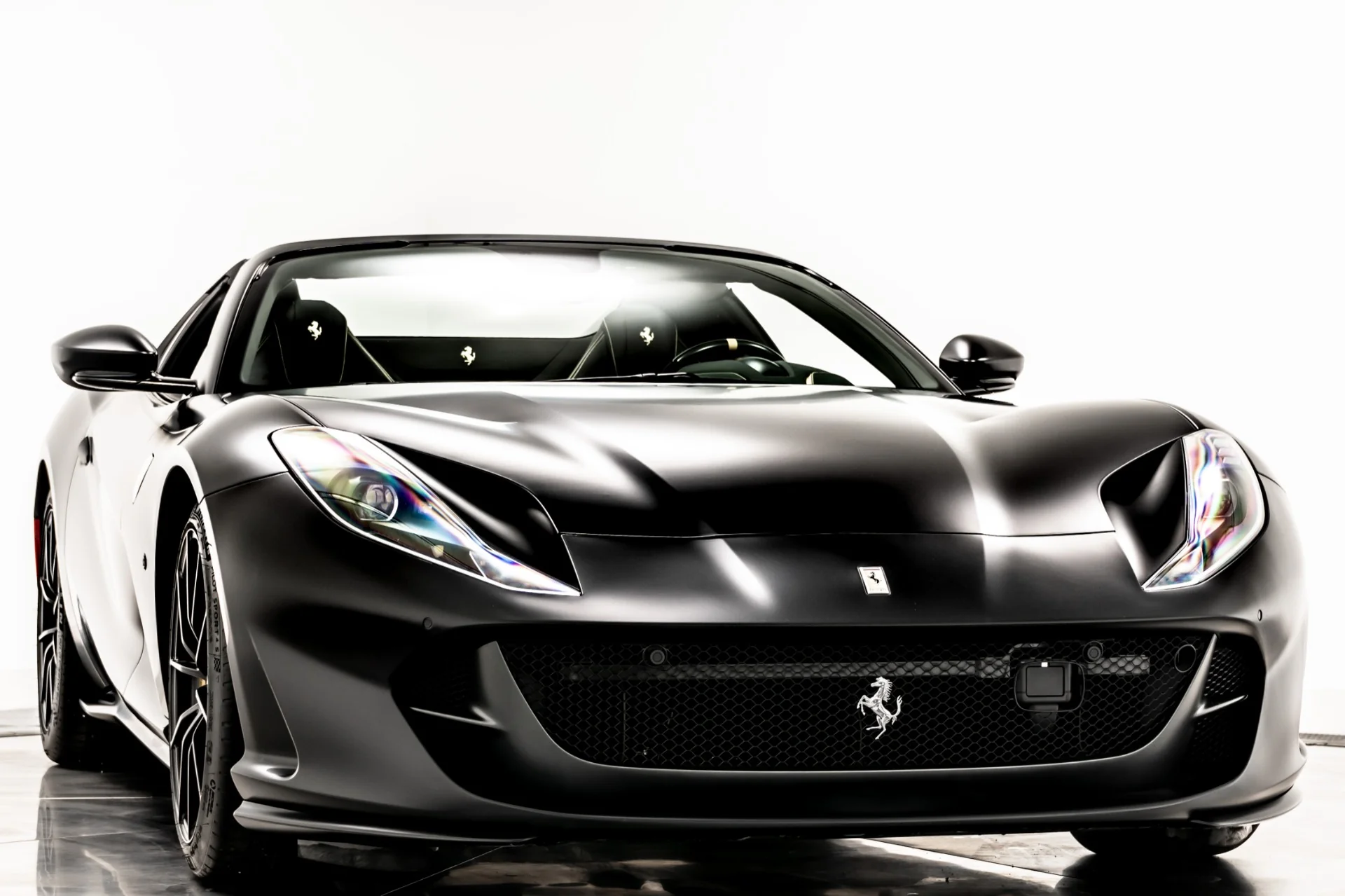
There is a moment when you press the red ENGINE START button on the steering wheel of a Ferrari 812 GTS and the 6.5-liter V12 erupts to life behind the long sculpted hood. The yellow analog tachometer needle sweeps to idle, the exhaust settles into a low, menacing baritone, and you understand — in a single heartbeat — that this is the last time Ferrari will ever build a car like this. No turbos. No hybrid. No electric motors. Just 789 horsepower of naturally aspirated fury screaming to 8,500 RPM with nothing between you and the sky.
The Ferrari 812 GTS is the last open-top car of Ferrari's front-engined 812 and F12 bloodline. Its successor, the 12Cilindri, has already arrived — and it kept the naturally aspirated V12, a 6.5-litre unit rated at 830 PS, while moving the cockpit to screens and the styling to an entirely different era. It is that combination — the end of a lineage rather than the end of aspiration — that has transformed the 812 GTS from a grand touring supercar into one of the most sought-after collector cars of the modern era.
The Last of Its Kind
Ferrari has built naturally aspirated V12 engines since 1947. It is the foundation of everything Maranello represents — the DNA that runs through every iconic model from the 250 GTO to the F12 Berlinetta. The 812 GTS carries the final evolution of that bloodline: the F140 GA engine, a 6,496 cc masterpiece that produces 789 hp at 8,500 RPM and 530 lb-ft of torque at 7,000 RPM. It was the most powerful naturally aspirated V12 Ferrari had put in a series-production road car when the GTS launched; the 812 Competizione and, later, the 12Cilindri have since gone beyond it at 830 PS.
No turbochargers muffle the intake scream. No electric motors blur the connection between throttle and sound. The 812 GTS delivers every one of its 789 horses through a direct, visceral mechanical chain — crankshaft to flywheel to seven-speed dual-clutch gearbox to rear wheels. When you pin the throttle wide open, the engine note changes character three distinct times between 3,000 and 8,500 RPM, each shift in harmonic intensity more violent than the last.
Mechanical Tachometer — A Dying Art
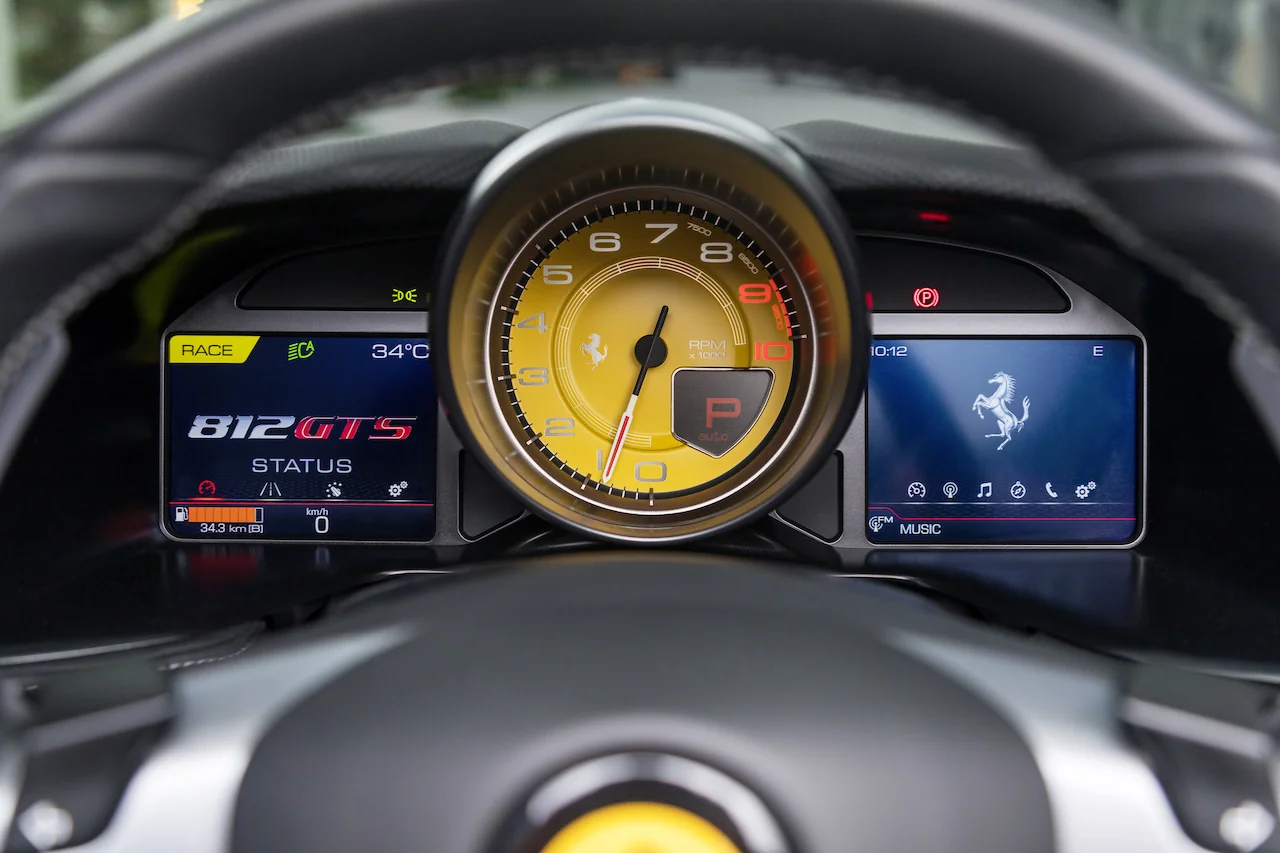
In an era where every competitor has switched to fully digital instrument clusters, Ferrari made a deliberate choice with the 812 GTS. The centerpiece of the cockpit is a large, yellow analog tachometer — a physical, mechanical rev counter with a traditional needle that sweeps across its face as the engine climbs toward redline. It is flanked by a digital display for secondary information, but the tachometer itself is unmistakably analog. A needle. A dial. A yellow face marked to 10,000 RPM.
This is not nostalgia for its own sake. Ferrari engineers understood that a physical needle responding to real-time engine vibrations creates a connection that no screen can replicate. You feel the needle accelerate. You watch it sweep. You develop an instinct for where redline lives without ever looking at a number. The 812 GTS is the last Ferrari where this experience exists.
The Red Button on the Steering Wheel
Every Ferrari since the Enzo has carried its engine start button on the steering wheel — a tradition borrowed directly from Formula 1. On the 812 GTS, it is a physical, mechanical red button marked ENGINE START STOP, set into a carbon fiber spoke of the steering wheel. Beside it sits the Manettino — the rotary driving mode selector that controls traction, stability, and suspension mapping across five modes from Wet to ESC Off.
These are not capacitive touch surfaces. Not haptic feedback pads. They are real, physical controls that click and rotate with precision. In a world moving toward touchscreens and gesture controls, the 812 GTS cockpit is a monument to the idea that the interface between driver and machine should be tactile, immediate, and mechanical.
Why Collectors Are Paying Attention
The mathematics of collectibility are simple. The Ferrari 812 GTS is the last open-top V12 of the 812 and F12 bloodline. It has the last mechanical tachometer. The last physical start button on the wheel. Zero turbochargers. Zero hybrid components. Zero electric motors. It is pure internal combustion — the closing chapter of the front-engined V12 grand tourer as Ferrari built it for three generations, and part of a V12 tradition that began with Gioacchino Colombo's original 1.5-liter unit in 1947.
Production ended in 2023. Every unit that leaves a dealership now is pre-owned, and values have already begun their climb — a pattern Ferrari itself keeps feeding by drawing hard lines under eras, as it did with the non-hybrid V8 spider in the HC25 one-off. The Atelier editions — bespoke configurations built through Ferrari's personalization program with unique color combinations, interior materials, and trim details — command the highest premiums. These are not just cars. They are time capsules of the last era when a naturally aspirated engine could pass emissions regulations at this displacement and power level.
"The 812 GTS represents the absolute pinnacle of the front-mounted V12 architecture. It is the purest expression of what Ferrari has always been." — Ferrari Chief Technology Officer, Michael Leiters
The Batman Garage Verdict
The Ferrari 812 GTS is not just a supercar. It is a statement — a 789-horsepower declaration that some things should never be diluted by turbines, batteries, or touchscreens. The yellow tachometer needle climbing toward 8,500 RPM is not a display. It is a heartbeat. The red start button is not a convenience. It is a ritual. And the V12 scream at full throttle with the roof retracted is not just sound — it is the final chorus of an era that will never return.
Bruce Wayne would understand. Some machines are not measured by their lap times or their power figures. They are measured by what they make you feel when the engine fires and the world disappears. The Ferrari 812 GTS is that machine. The last of its kind. And the darkness has never sounded this good.