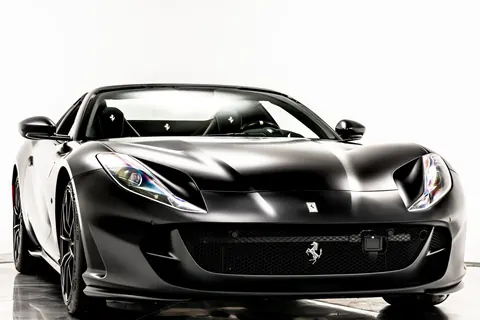
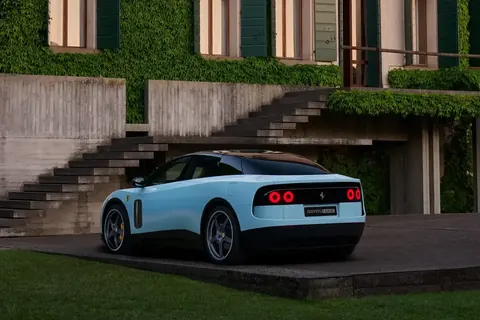
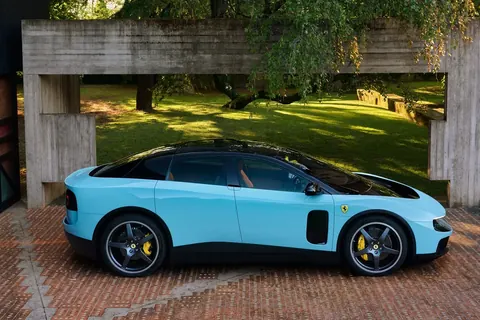
Ferrari has revealed the HC25, a one-off Special Projects roadster commissioned by a single client and unveiled during Ferrari Racing Days at the Circuit of the Americas on May 15, 2026. Designed by the Ferrari Design Studio under Flavio Manzoni, the car is built on the chassis and twin-turbocharged V8 powertrain of the now-discontinued F8 Spider — the last unassisted V8 mid-engined Spider Maranello has built.
UPDATE · SEPTEMBER 16, 2026
Nothing about the HC25 has been revised in the four months since the Austin reveal. Ferrari has still not disclosed the price, named the client, or said whether the project will lead to further cars, and the published specification — 720 cv from the F154 CG twin-turbo V8, 2.9 s to 100 km/h, 340 km/h — remains exactly that of the donor F8 Spider, with no independent test published. Maranello's Special Projects department has stayed busy elsewhere, most visibly with the SF90-based Ferrari CZ26 shown at Monterey, while the series range keeps moving toward electrification with the Ferrari Luce. As of September 2026 the HC25 still reads as a closing statement rather than the start of a line.
Editor's note: Output figures cited follow Ferrari's official European homologation (720 cv at 7,000 rpm, 770 Nm at 3,250 rpm), with U.S.-spec equivalents from Car and Driver (710 hp, 568 lb-ft). Top speed, dimensions and acceleration figures match the donor F8 Spider; production is confirmed at a single unit.
Design — A Dual-Volume Spider Between F80 and 12Cilindri
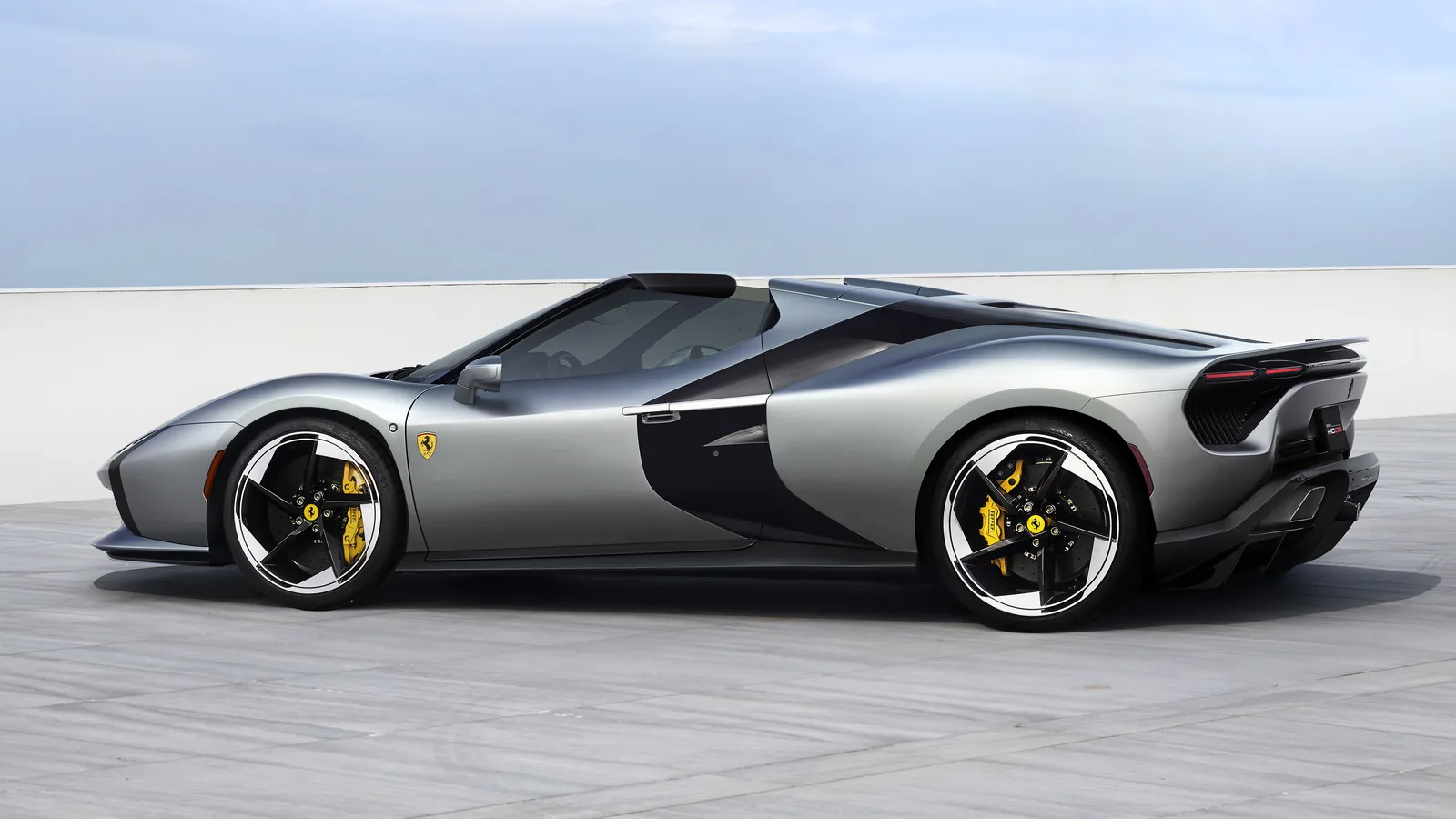
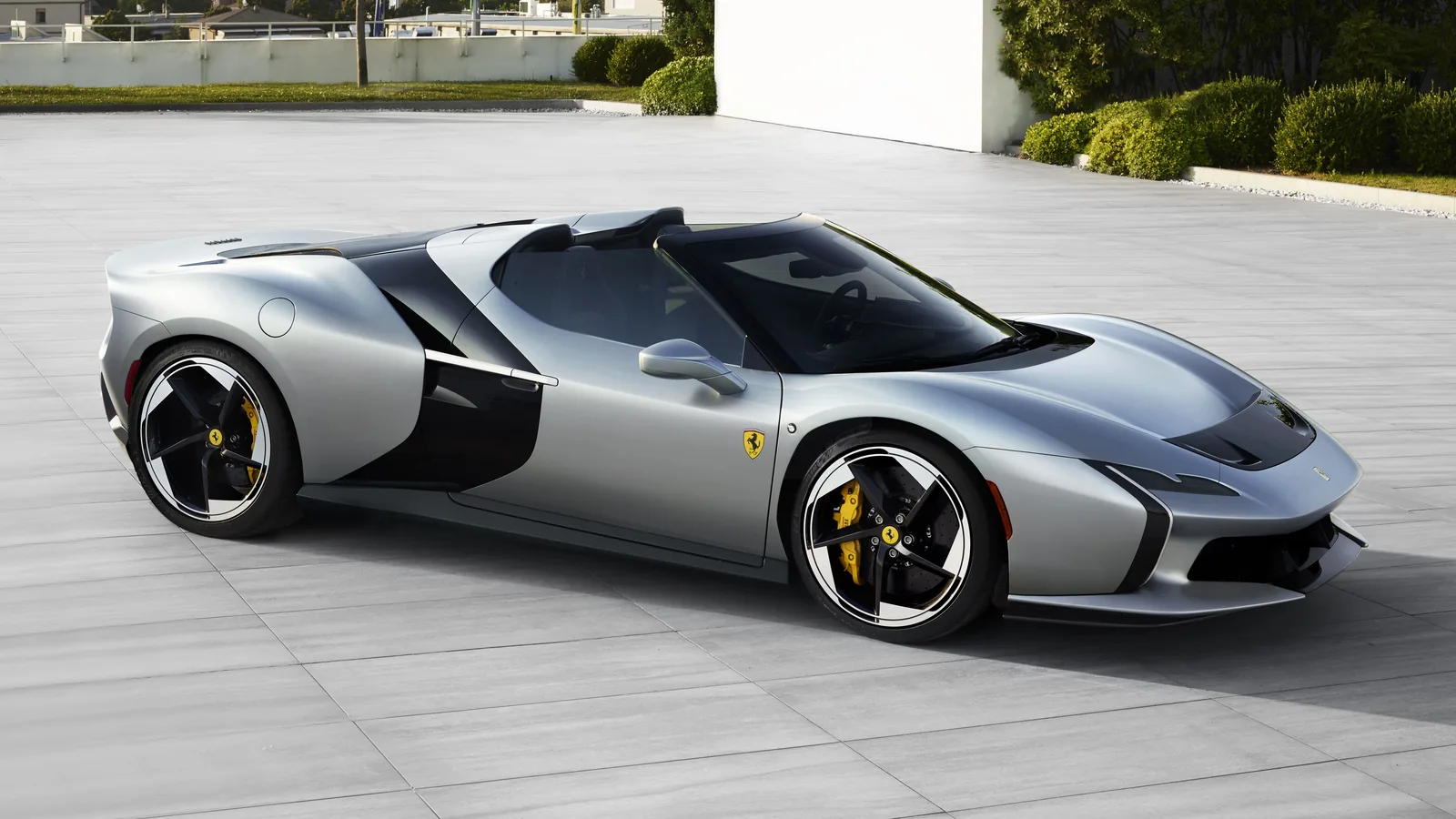
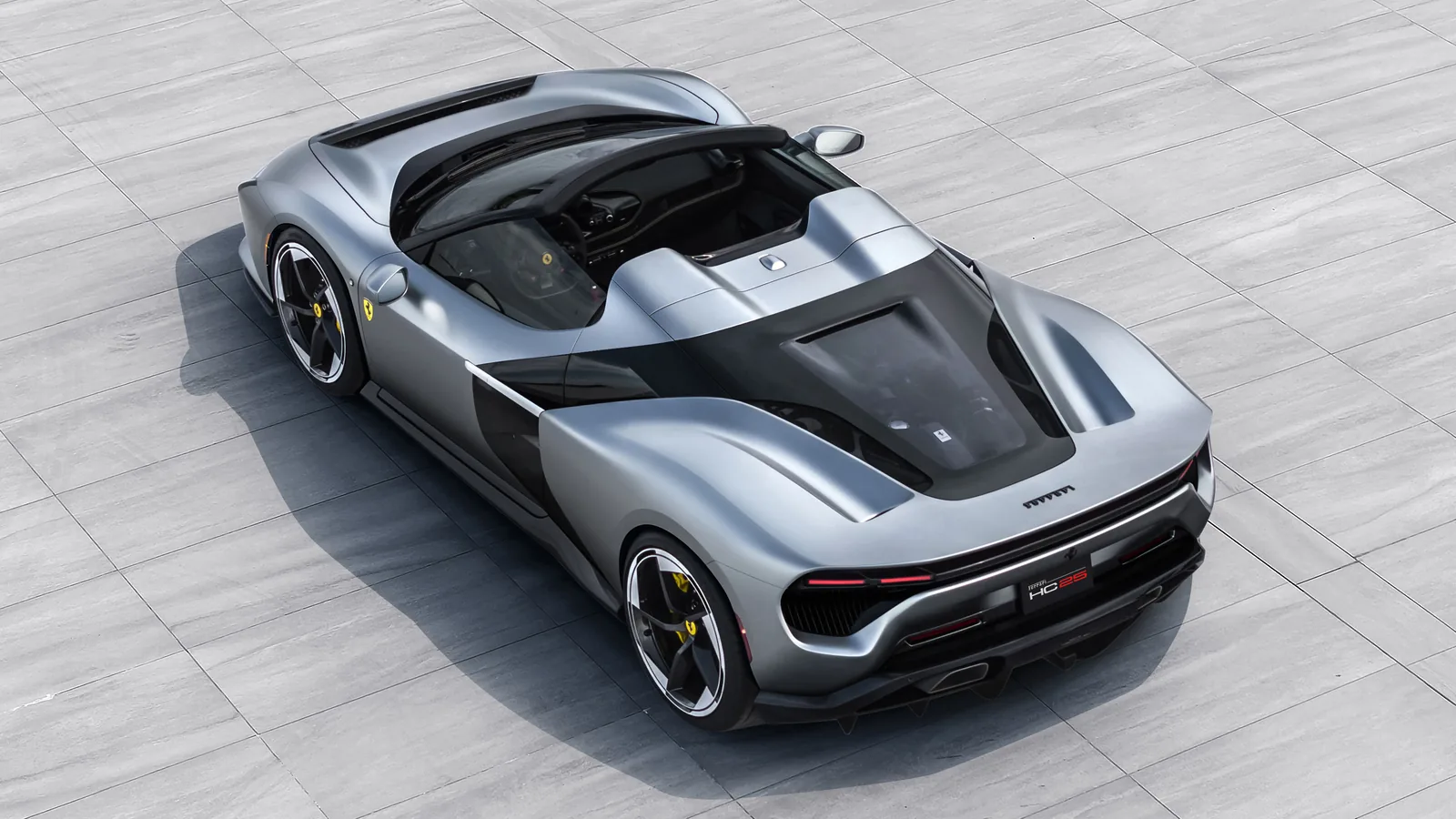
The HC25 carries the proportions of the F8 Spider — short wheelbase, mid-engine layout, open cabin — but every surface above the floor is new. Ferrari Centro Stile describes the bodywork as a "dual-volume" architecture in which the front and rear of the car are treated as separate sculptural masses, divided by a continuous glossy-black ribbon. The ribbon runs from the front fender into the cabin, drops across the side intakes, wraps under the rear deck and feeds the engine bay.
The ribbon is functional as well as graphic. Within it sit the radiator extraction ducts, side air intakes for the V8 and the door cut-line; the door handles themselves are integrated into a single milled-aluminium bar that interrupts the black band. The body is finished in Matte Moonlight Grey, a bespoke colour developed for this car only.
Visual cues from Ferrari's current flagships are deliberate. The headlight signature with its vertically oriented daytime running light is borrowed from the F80; the surfacing of the rear haunches and the split tail-light architecture reference the 12Cilindri. Ferrari has stated that the car's purpose is to "bridge" the brand's last non-hybrid V8 platform and its current design language.
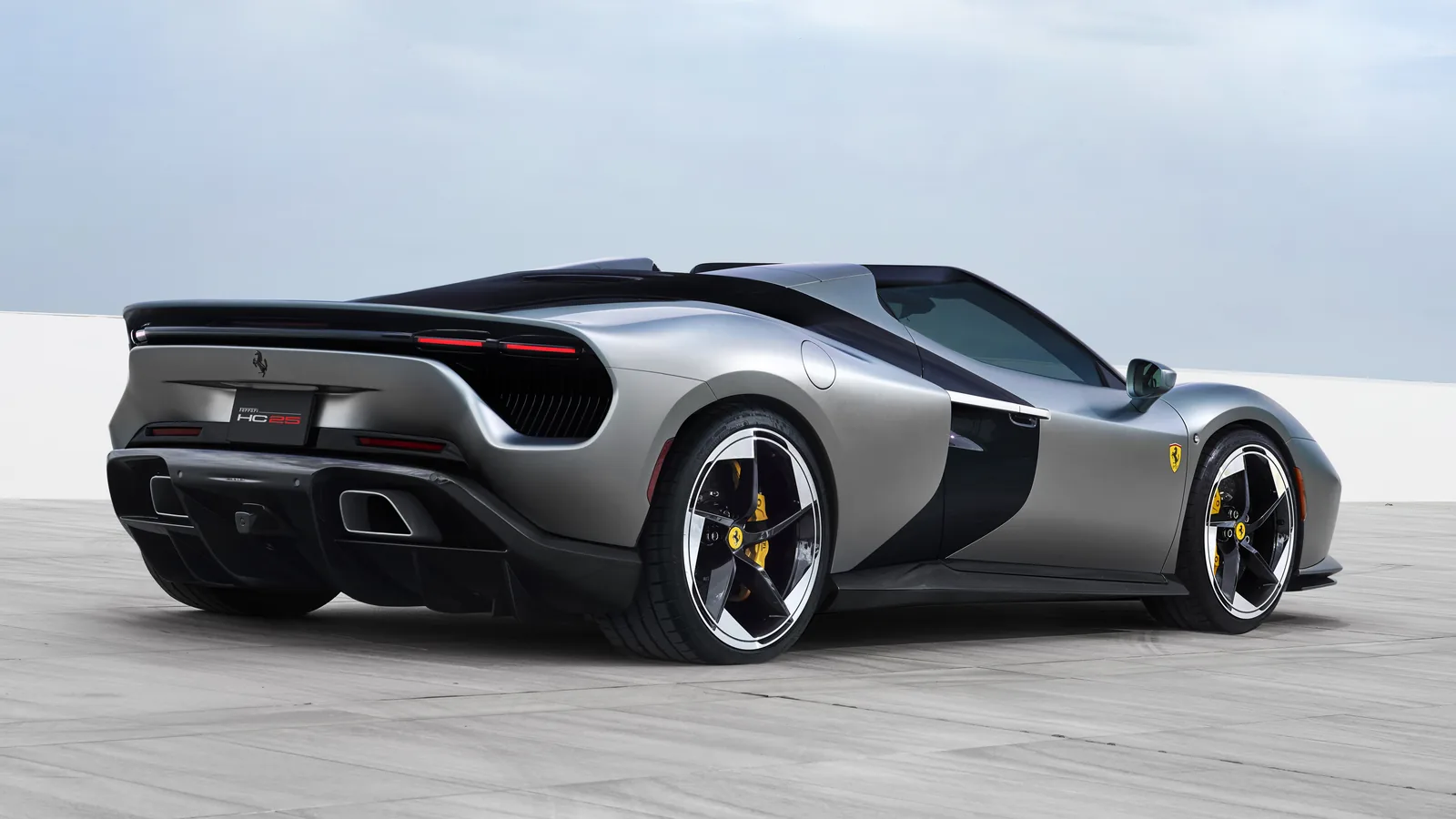
The Dual-Body Black Ribbon Explained
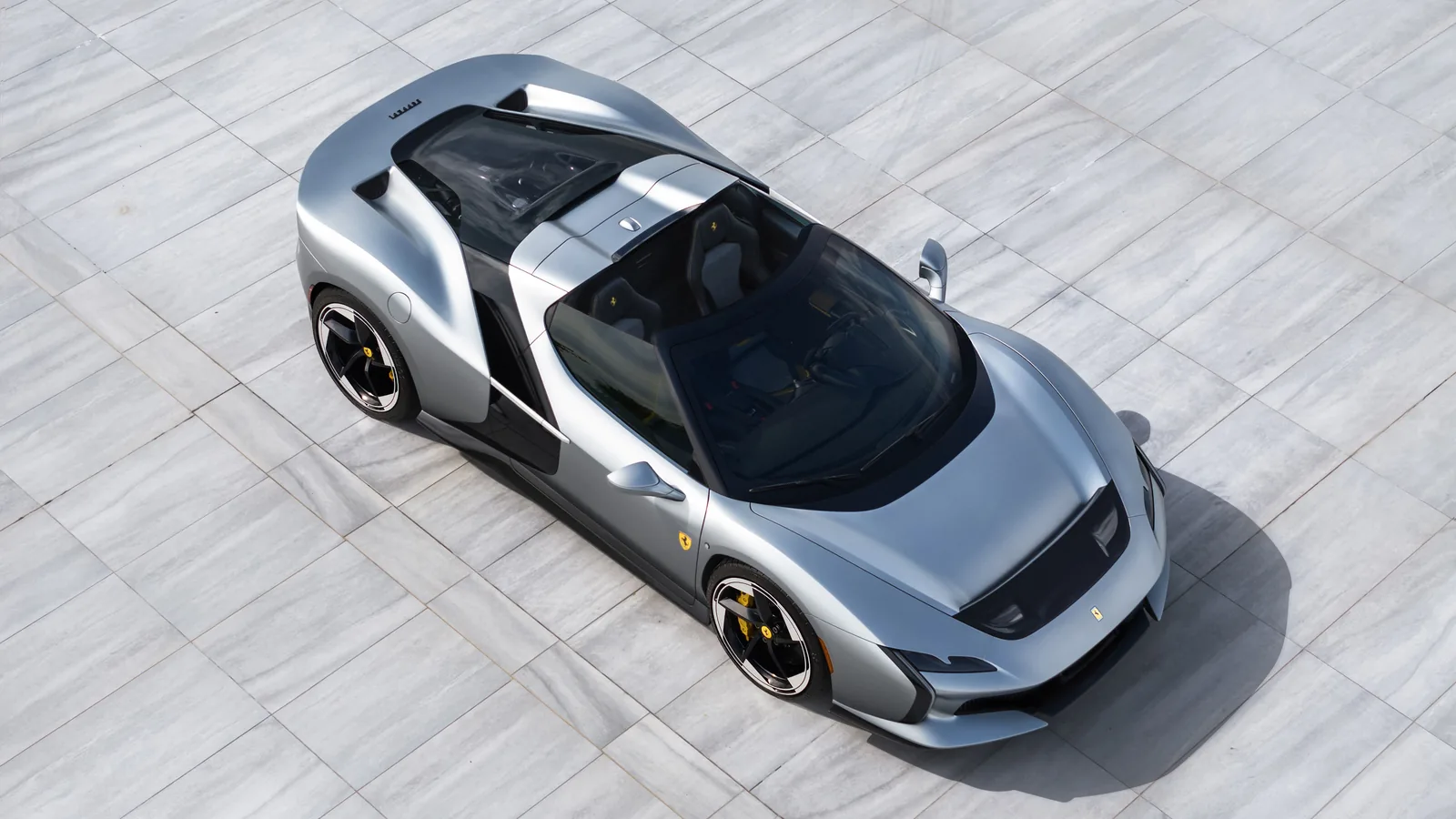
Ferrari describes the central black graphic as a "central technical body" that visually separates the front and rear volumes. From the side, the lower edge of the ribbon traces a wedge that pushes the visual centre of gravity forward, lowering the perceived shoulder line of the car — a stated objective of the design brief. From above, the ribbon resolves into a closed roof segment that contains the rollover structure and the rear glass.
Powertrain — F154 CG Twin-Turbo V8, Unchanged
The HC25 retains the donor F8 Spider's powertrain without modification: a 3,902 cc (3.9 L) Ferrari F154 CG 90-degree V8 with twin turbochargers, mounted in the mid-rear position and driving the rear wheels through a seven-speed dual-clutch transmission. Peak output is 720 cv (710 hp / 530 kW) at 7,000 rpm with 770 Nm (568 lb-ft) of torque at 3,250 rpm — a specific output of 185 hp per litre.
Ferrari quotes 0–100 km/h in 2.9 seconds, 0–200 km/h in 8.2 seconds and a top speed of 340 km/h (211 mph). The chassis is the F8 Spider's aluminium spaceframe, retained with no changes to suspension geometry, magnetorheological damper calibration or electronic systems (E-Diff, F1-Trac, Side Slip Control). The non-hybrid V8 layout — no electric motor, no battery, no torque-fill — is what positions the HC25 as a closing chapter of Ferrari's unassisted mid-engine V8 era.
Interior — Nero Leather, Alcantara, Giallo Stitching
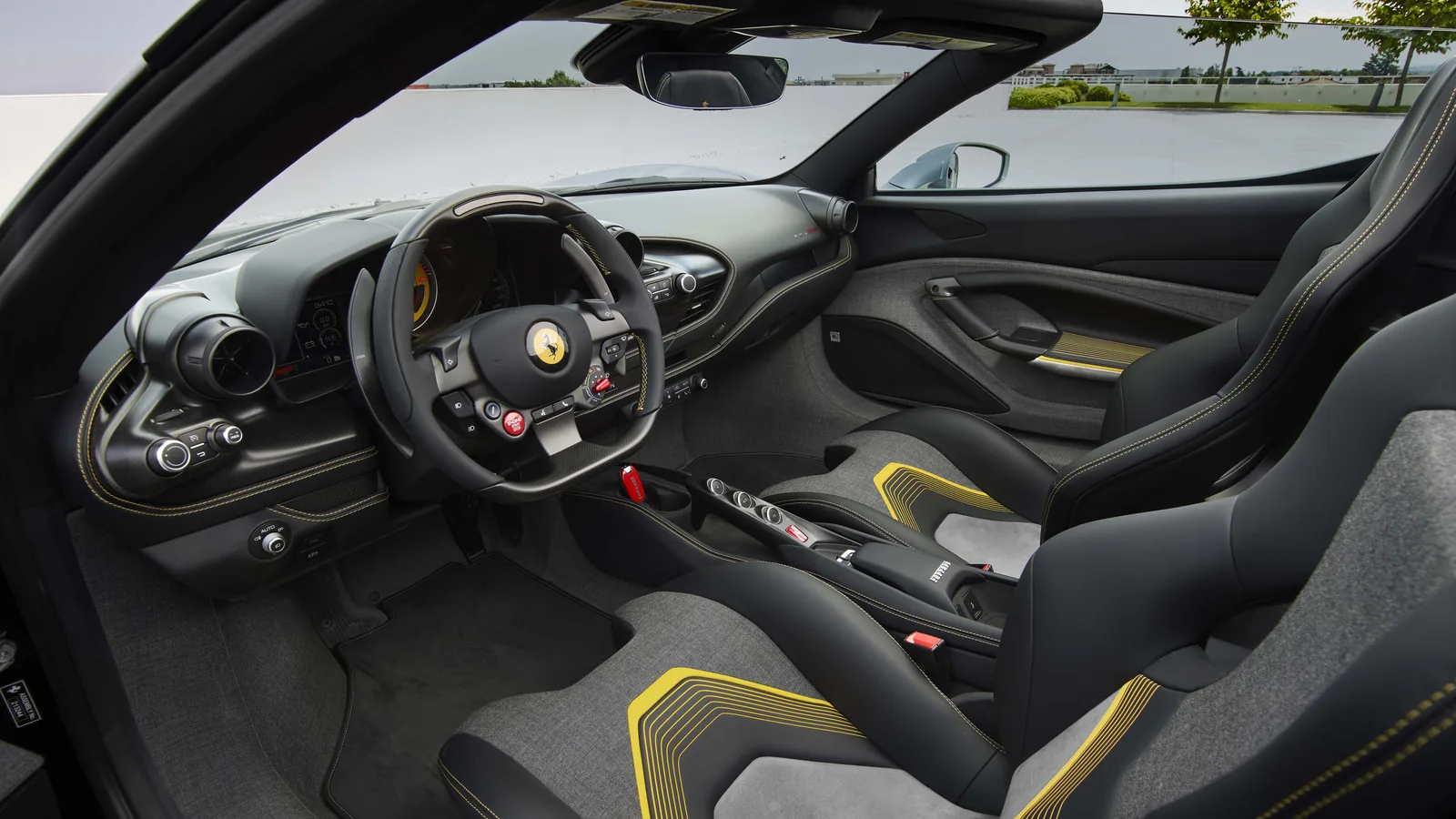
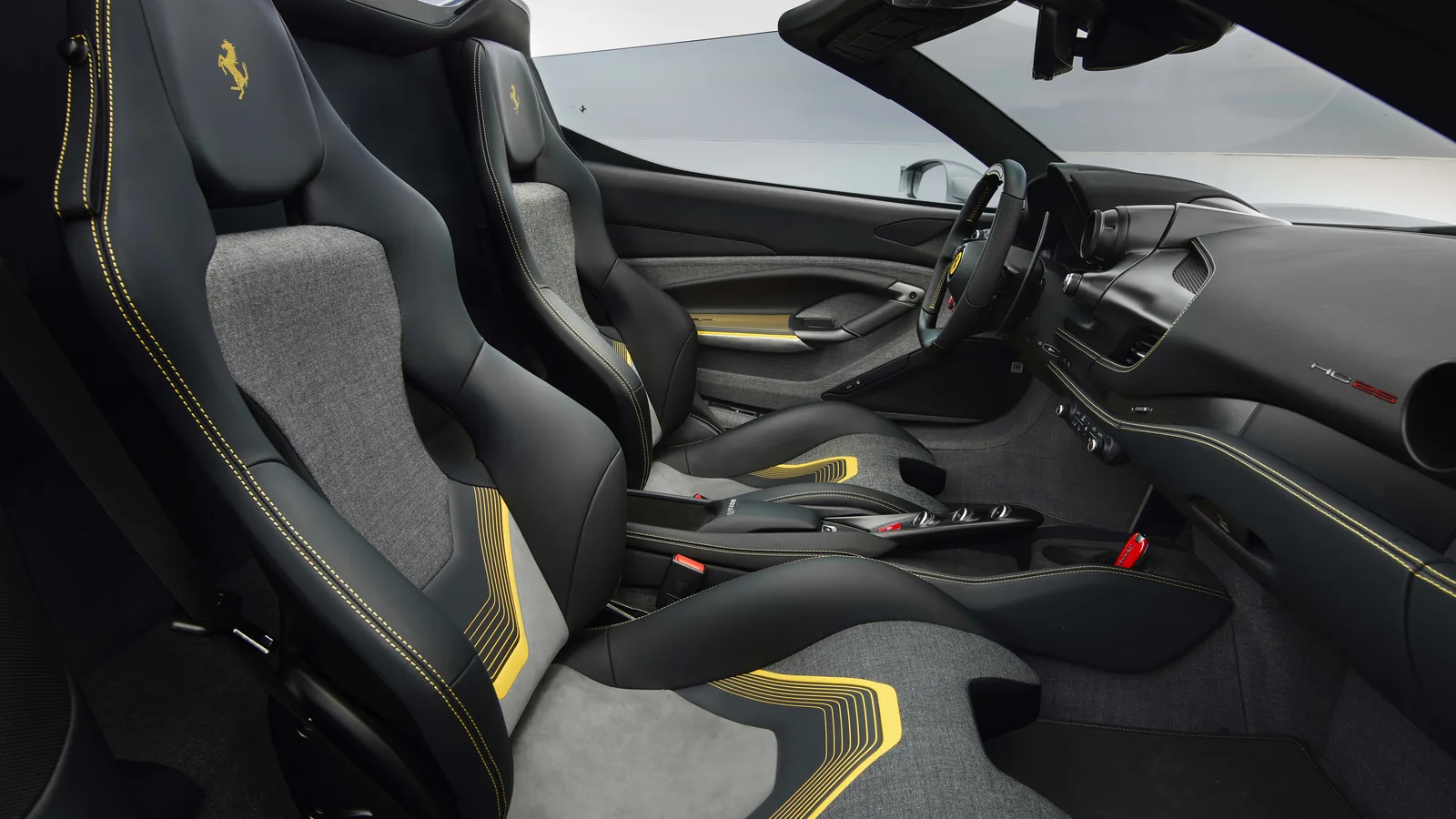
Cabin architecture matches the F8 Spider: the same digital cluster ahead of the driver, the same horizontal dashboard with passenger display, the same manettino on the steering wheel. The bespoke layer sits on top: technical grey fabrics, Nero leather, Alcantara inserts and Giallo (yellow) contrast stitching applied along seat bolsters, dashboard and door cards. The seat backs and bottoms carry the same boomerang motif used by the exterior daytime running lights, picked out in yellow against grey.
Brembo Carbon-Ceramic Brakes
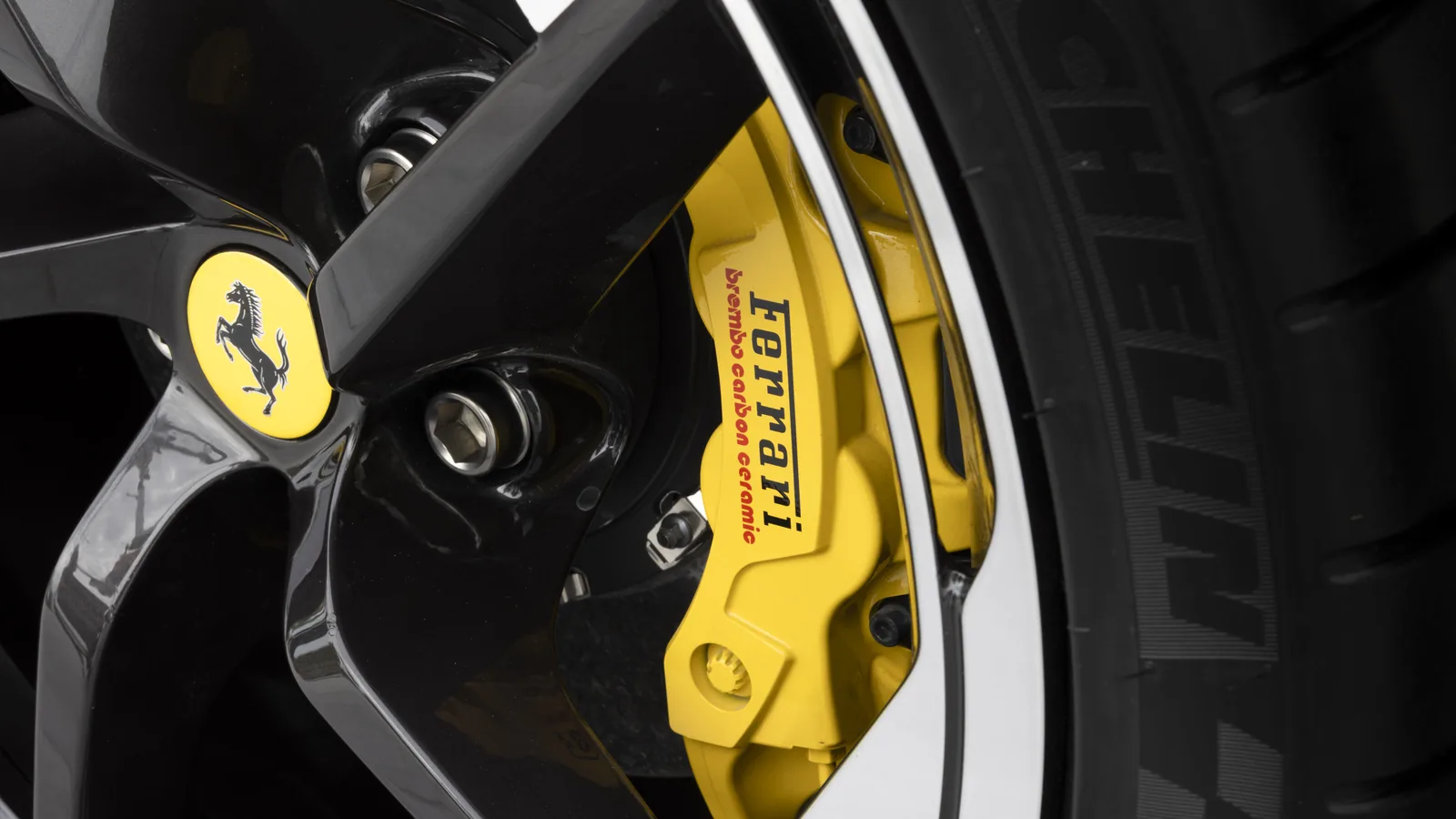
Carbon-ceramic discs by Brembo are retained from the F8 Spider, paired with the same six-piston front and four-piston rear caliper hardware finished in Giallo Modena. The decision to keep the donor car's brake system is consistent with the HC25 brief — preserve the F8 Spider's dynamic envelope intact, change only the body and trim.
Specifications
| Specification | Ferrari HC25 (2026) |
|---|---|
| Layout | Mid-rear engine, rear-wheel drive |
| Engine | Ferrari F154 CG, 3,902 cc twin-turbocharged 90° V8 |
| Max power | 720 cv (710 hp / 530 kW) @ 7,000 rpm |
| Max torque | 770 Nm (568 lb-ft) @ 3,250 rpm |
| Specific output | 185 hp per litre |
| Transmission | 7-speed dual-clutch (DCT), electronically managed E-Diff |
| 0–100 km/h (0–62 mph) | 2.9 s |
| 0–200 km/h (0–124 mph) | 8.2 s |
| Top speed | 340 km/h (211 mph) |
| Length | 4,758 mm |
| Width | 2,006 mm |
| Height | 1,183 mm |
| Wheelbase | 2,650 mm |
| Cargo volume | 200 L |
| Chassis | Aluminium spaceframe (F8 Spider donor) |
| Brakes | Brembo carbon-ceramic, six-piston front / four-piston rear |
| Suspension | Double wishbone front / multi-link rear, magnetorheological dampers |
| Electronics | Side Slip Control, F1-Trac, E-Diff (carried over from F8 Spider) |
| Exterior colour | Matte Moonlight Grey (bespoke) |
| Interior | Nero leather / Alcantara with Giallo stitching |
| Designer | Flavio Manzoni, Ferrari Centro Stile |
| Production | 1 (one-off) |
| Reveal | May 15, 2026, Ferrari Racing Days, Circuit of the Americas |
| Price | Not disclosed |
| Owner | Not disclosed |
Ferrari HC25 vs F8 Spider — What Is Actually New
Mechanically, the HC25 is the F8 Spider. The engine, gearbox, chassis, suspension geometry, brakes and electronics are carried over without modification. What is new is exclusively cosmetic and dimensional: the bodywork is entirely bespoke, the car is 147 mm longer than the F8 Spider, 27 mm wider and 23 mm lower, the wheels are a unique five-spoke design and the cabin trim is one-of-one. The performance figures are therefore unchanged from the donor car, and Ferrari has made no claim to the contrary.
Significance — The Last Unassisted V8 Spider
Ferrari's series-production V8 mid-engine line has moved on. The current 296 GTB and 296 GTS run a hybridised V6; the SF90 Spider runs a hybridised V8. The F8 Spider, on which the HC25 is based, ended production in 2023 and was the last open-top V8 Ferrari built without electric assistance. Because the HC25 retains the F8 Spider's powertrain unchanged, it effectively extends — by a single unit — the production life of Ferrari's unassisted V8 mid-engine Spider configuration. Ferrari has not disclosed the price, the identity of the client or whether further HC25-derived one-offs are planned.
Sources
- Car and Driver — The Ferrari HC25 Is a Sleek One-Off Supercar with a 710-HP V-8
- Top Gear — The HC25 Is a One-Off, Rebodied V8 Ferrari F8 Spider
- Exclusive Car Registry — Ferrari HC25 Profile
- alVolante.it — Ferrari HC25: la one-off che celebra il V8 puro
- Autoblog / Yahoo Autos — Ferrari Reveals HC25 As A Unique F8 Spider-Based Supercar