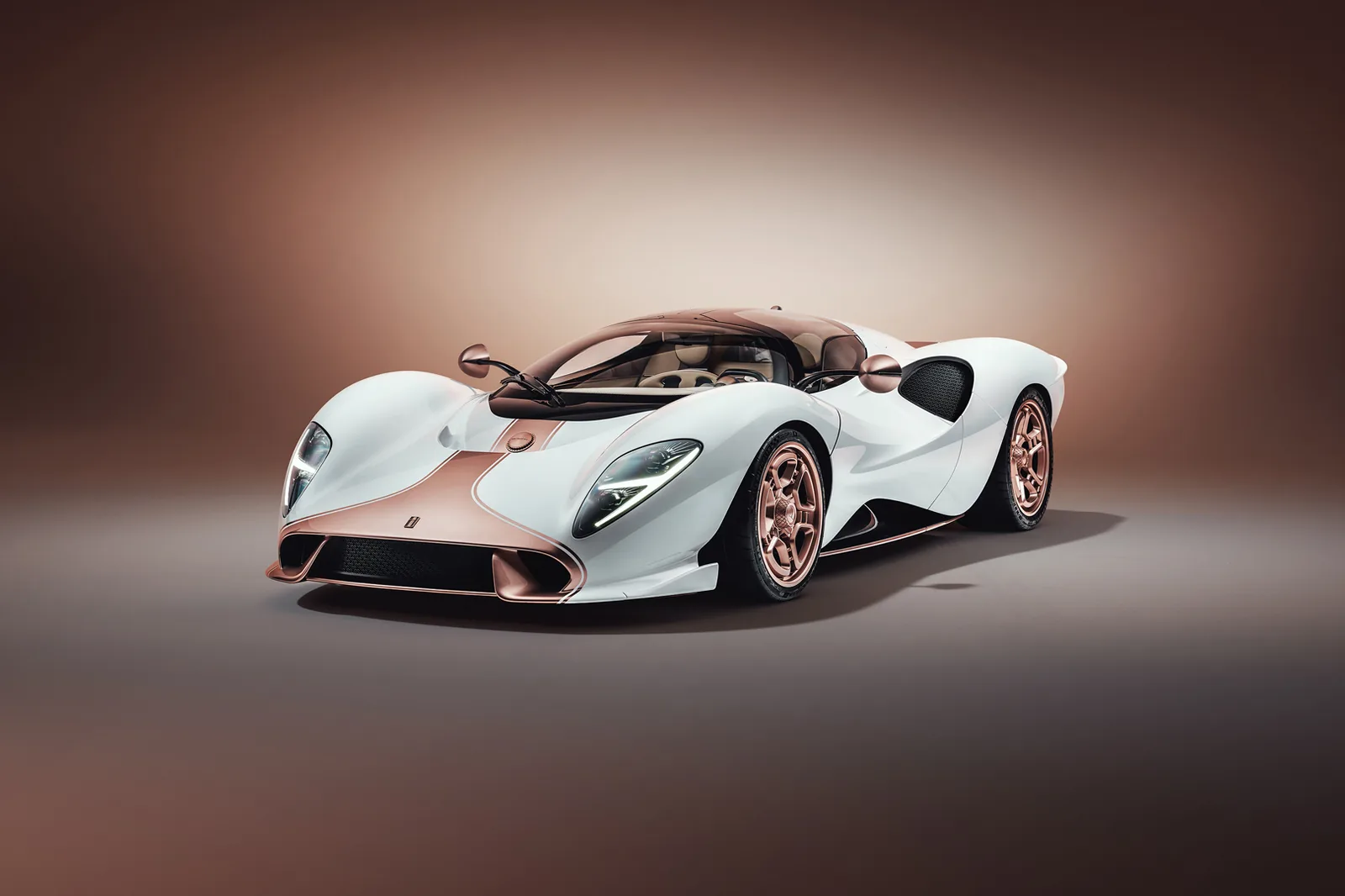
In an era of 2,000-horsepower electric hypercars and screen-filled cockpits, the De Tomaso P72 arrives as a deliberate counter-proposal. Almost seven years after its 2019 Goodwood Festival of Speed debut, the reborn Italian marque has moved from concept to delivered car: the production specification was unveiled on 14 May 2025 in Affalterbach, Germany, and the first customer example was presented on 2 June 2026. The formula did not soften along the way — a supercharged V8, a six-speed manual, a single-piece carbon monocoque and almost no screens at all.
First Customer Car Delivered: “Aurelian Night”
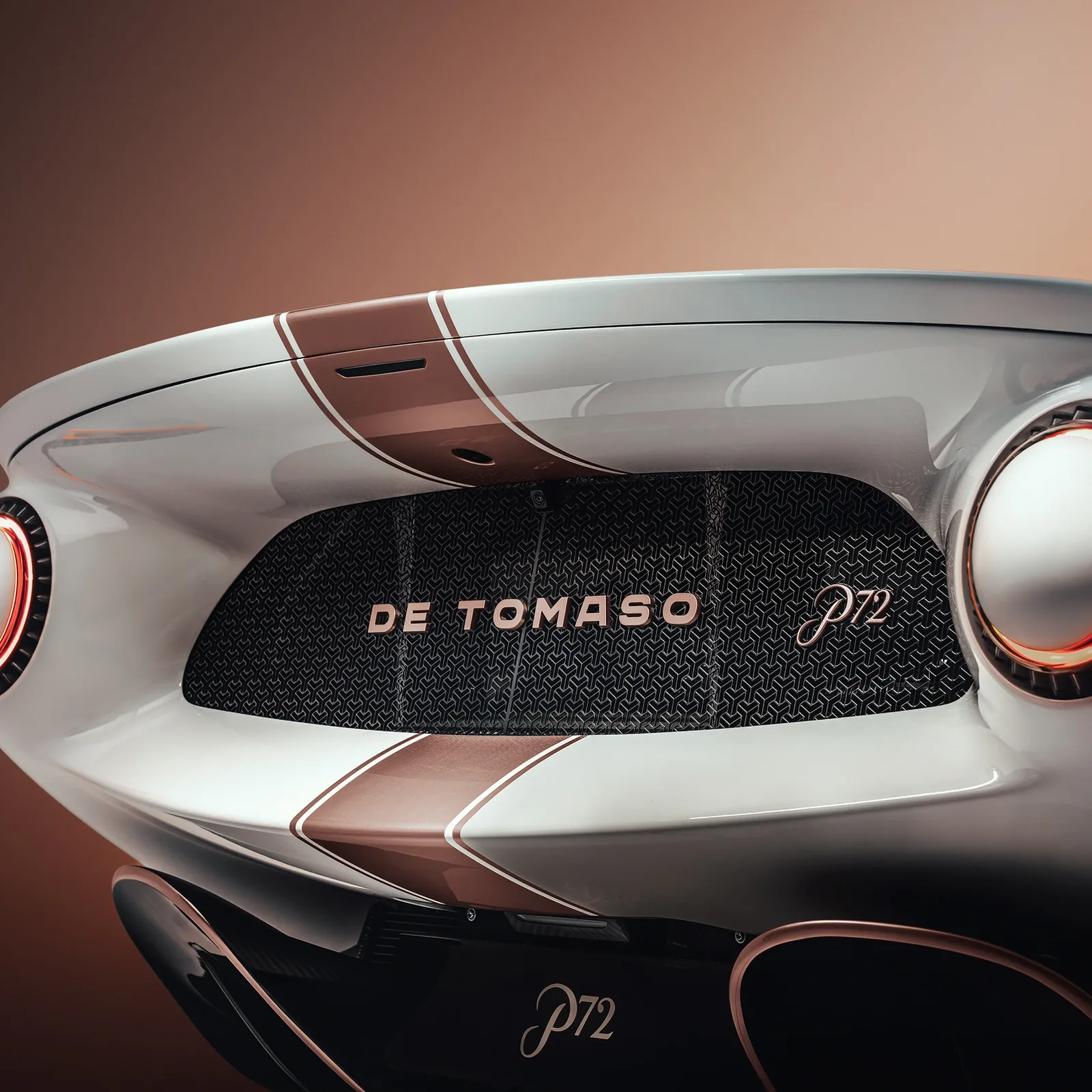
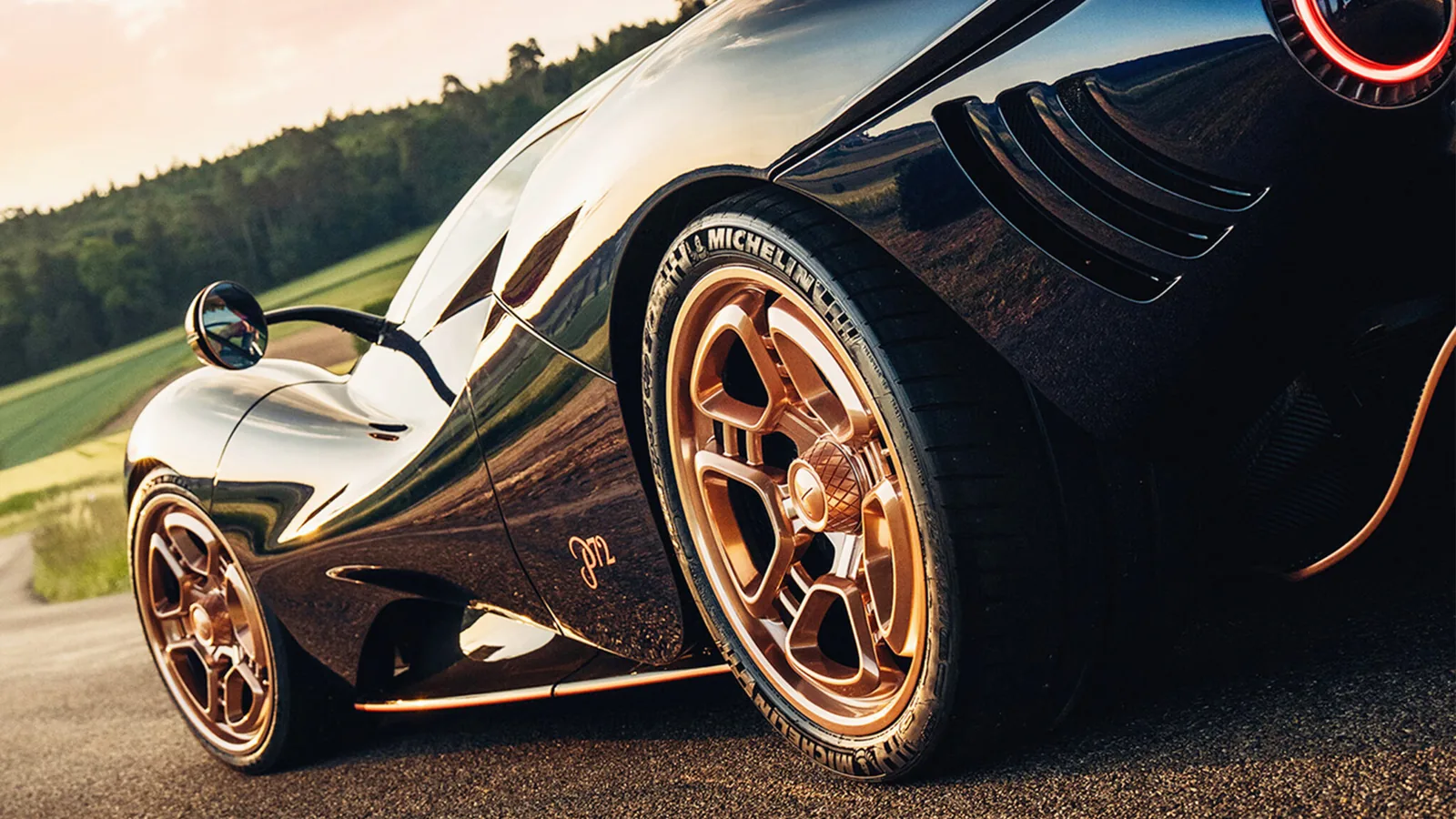
The single most significant development since the production reveal is that the P72 is no longer a show car. The first customer-specification example, internally designated DT005 and commissioned under the name “Aurelian Night”, was officially presented on 2 June 2026. It wears a deep midnight-blue paint that reads almost black in low light, offset by hand-polished rose gold on the front splitter and intakes, a centre stripe running over the bonnet, roof and rear decklid, the side skirts, the rear diffuser, the centre-lock wheels and the wing mirrors. Inside, Venetian Blue leather is paired with knurled rose gold on the instruments, shifter, steering wheel, dashboard sections and door panels, with rose gold stitching.
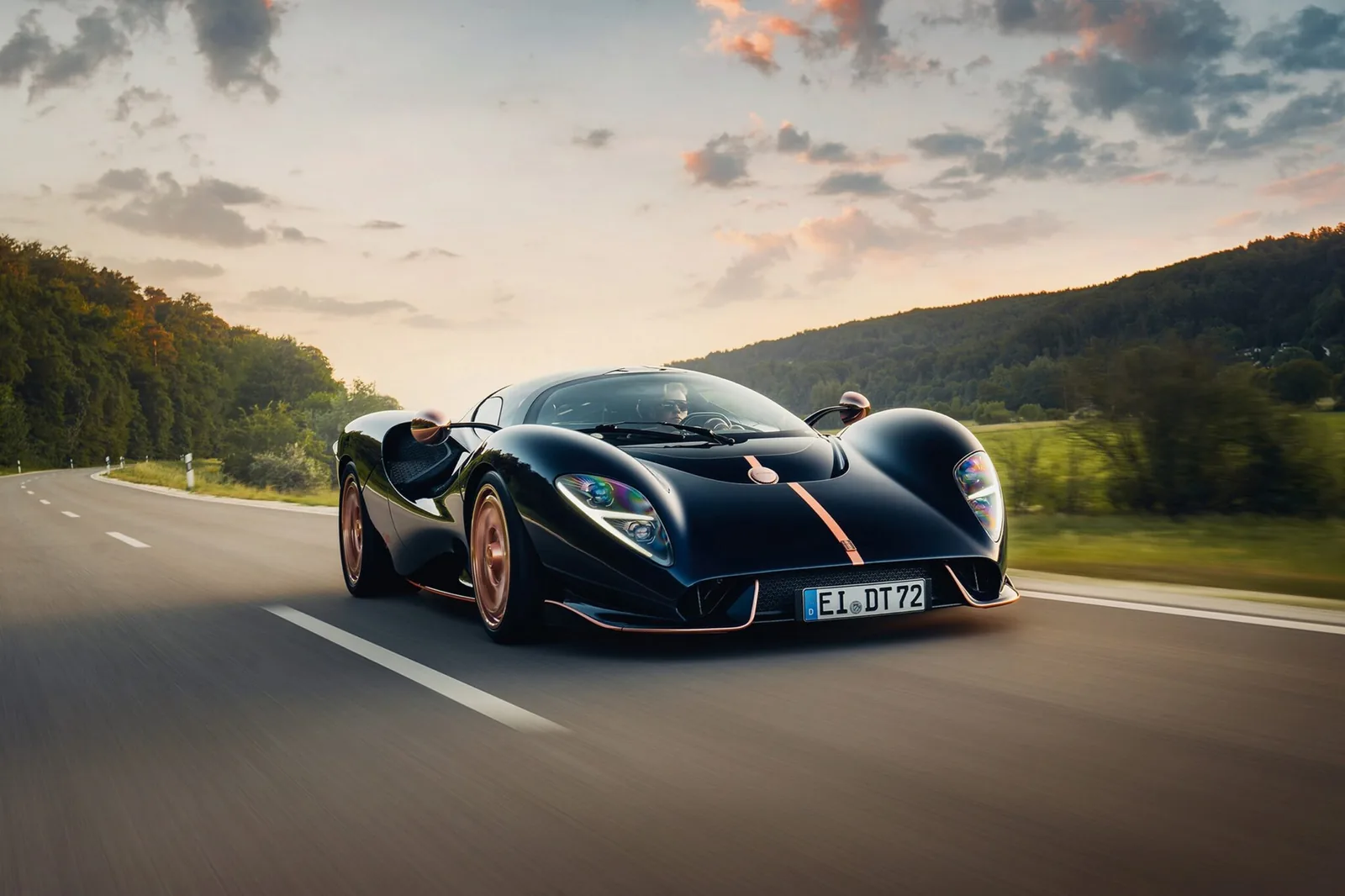
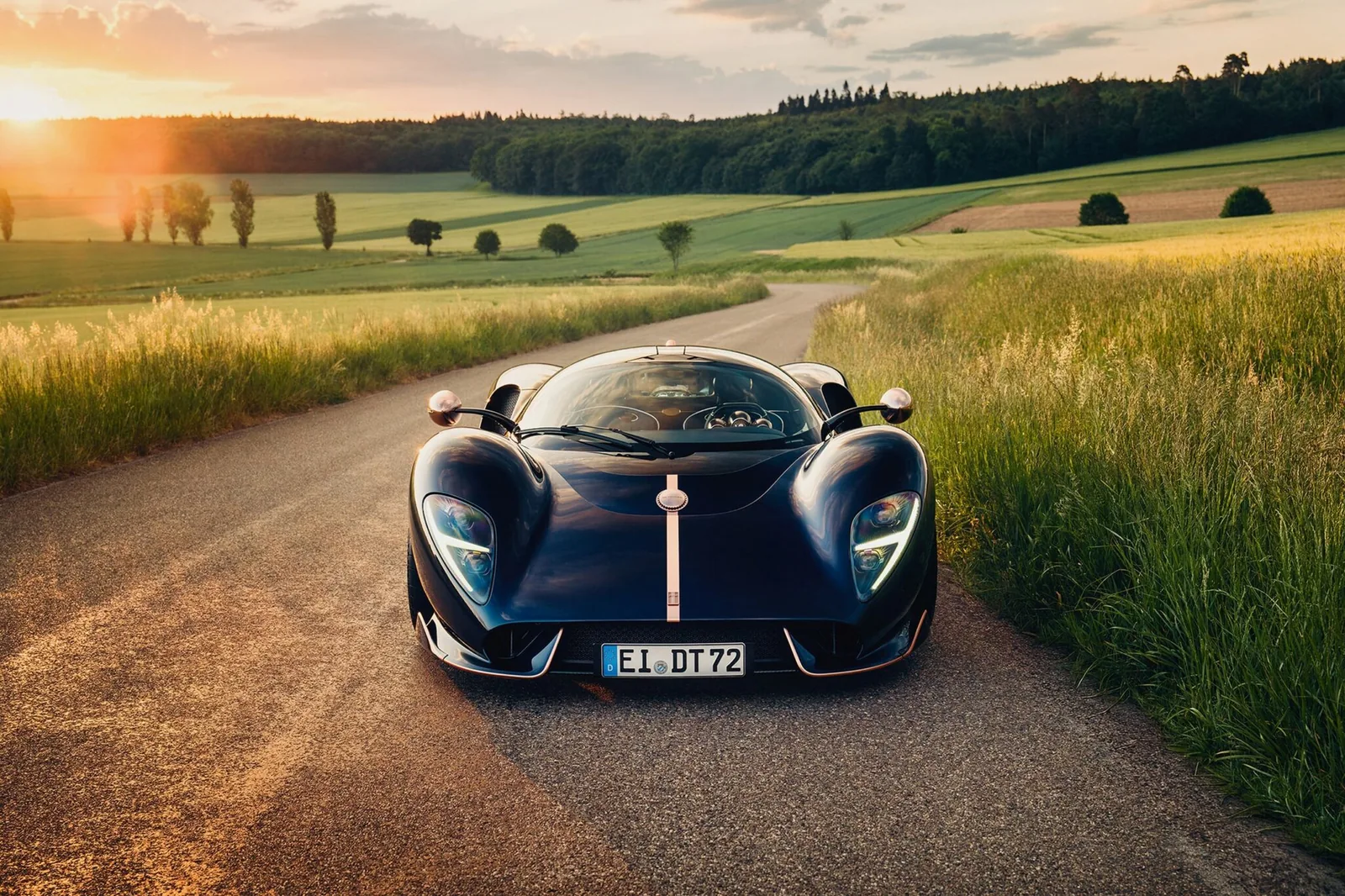
The timeline matters for anyone tracking the programme. De Tomaso stated at the May 2025 reveal that custodian deliveries would commence in late 2025. In practice, development cars DT002, DT003 and DT004 were still being used through the following autumn to refine ergonomics, mechanical calibration and carbon-fibre fitment, with DT005 designated as the first customer-level car. De Tomaso posted that its first P72 was “ready for delivery” on 24 April 2026, and the finished commission appeared publicly in June. Its owner has since been photographed with the car in Munich, Frankfurt and Monaco, which makes the P72 one of the very few sub-100-unit analog supercars actually being used on public roads.
An American Heart, Italian Soul
De Tomaso has always married Italian bodywork with American muscle — the Mangusta and the legendary Pantera both ran Ford V8s — and the P72 honours that tradition. At its core sits a hand-assembled supercharged 5.0-litre V8, derived from the Ford Coyote and tuned by Roush, fitted with bespoke forged internals and a De Tomaso-specific supercharger. It produces 700 horsepower and 820 Nm (604 lb-ft) of torque, driving the rear wheels through a six-speed manual gearbox.
Crucially, De Tomaso did not chase headline numbers. Company chairman Norman Choi prefers the linear delivery and soundtrack of natural aspiration, so the supercharger was specified to whine as little as possible, and the short gear ratios are tuned for "exhilarating in-gear performance" rather than a record 0-100 time.
De Tomaso P72 Specifications
The table below lists only figures De Tomaso itself publishes for the production car. The company is unusually restrictive about performance data, so anything absent here is absent because the manufacturer does not quote it.
| Engine | Hand-assembled supercharged 5.0-litre V8, Ford-derived, developed with Roush Performance |
|---|---|
| Internals | Bespoke forged internals, all-new De Tomaso supercharger, dry-sump lubrication |
| Power | 700 hp |
| Torque | 820 Nm (604 lb-ft) |
| Transmission | Six-speed manual with short ratios and exposed shift linkage |
| Drive | Mid-engine, rear-wheel drive |
| Chassis | Clean-sheet carbon fibre unibody monocoque, single uninterrupted piece, no bonded sections, 4x4 twill weave throughout |
| Subframes | Carbon fibre front and rear, integrated with the monocoque |
| Body | Full carbon fibre panels |
| Suspension | Push-rod, with a 3-way manually adjustable damping system |
| Fuel tank | 100 litres |
| Top speed / 0–100 km/h | Not quoted by De Tomaso |
| Production | 72 cars, each individually commissioned; the reveal car was built outside the 72 custodian allocations |
| Price | Approximately €1.6 million (roughly $1.8 million) |
| Key dates | Concept: Goodwood 2019 · Production spec: 14 May 2025 · First customer car: 2 June 2026 |
How Fast Is the De Tomaso P72? Top Speed and 0–100
This is the question the P72 refuses to answer. De Tomaso publishes no top speed and no acceleration figure — the only performance numbers in any official communication are 700 hp and 820 Nm. That is a positioning choice rather than an oversight: the short gear ratios, the supercharger specified to whine as little as possible and the road-biased 100-litre tank all point at a grand tourer rather than a lap-time weapon.
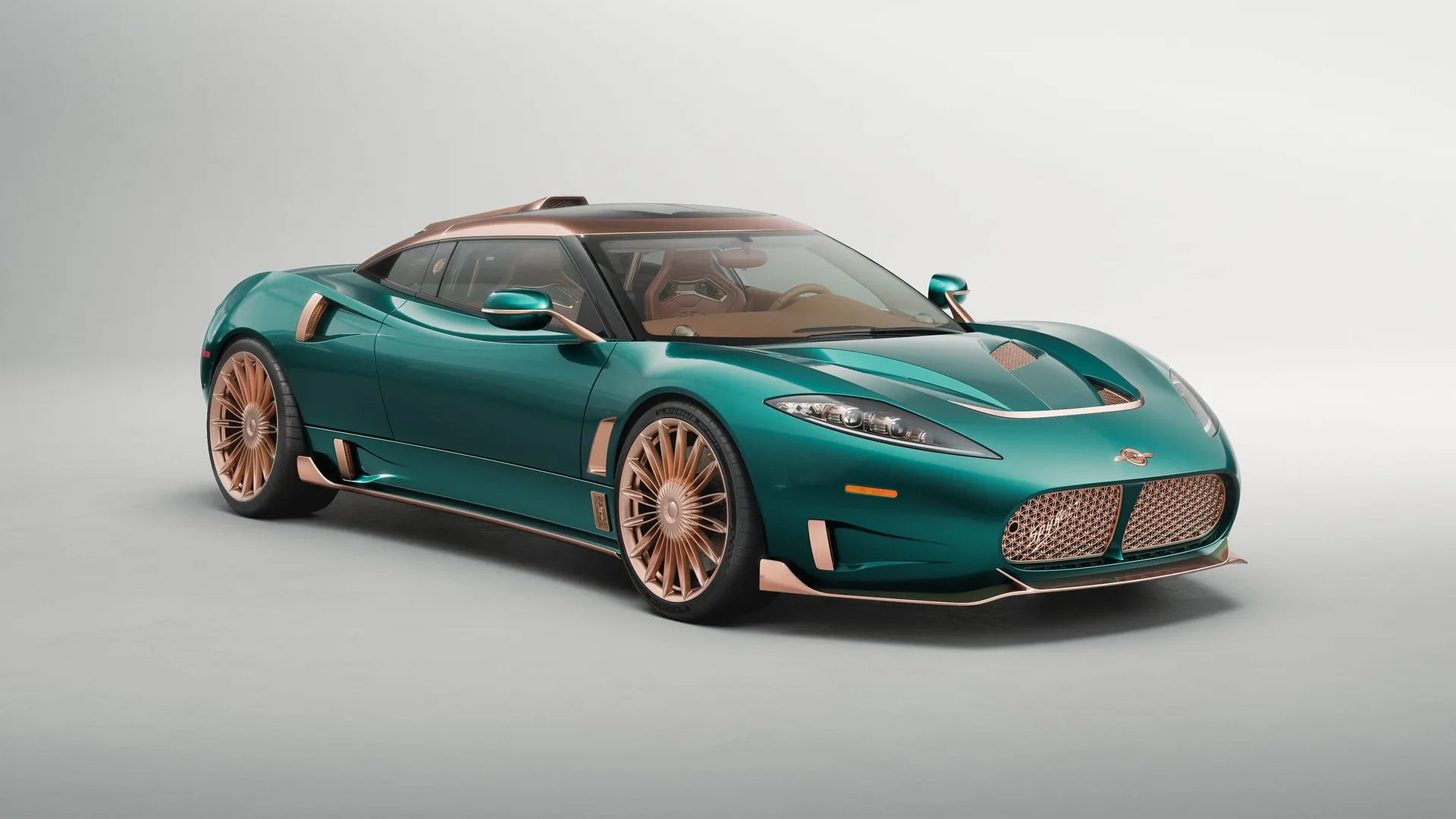
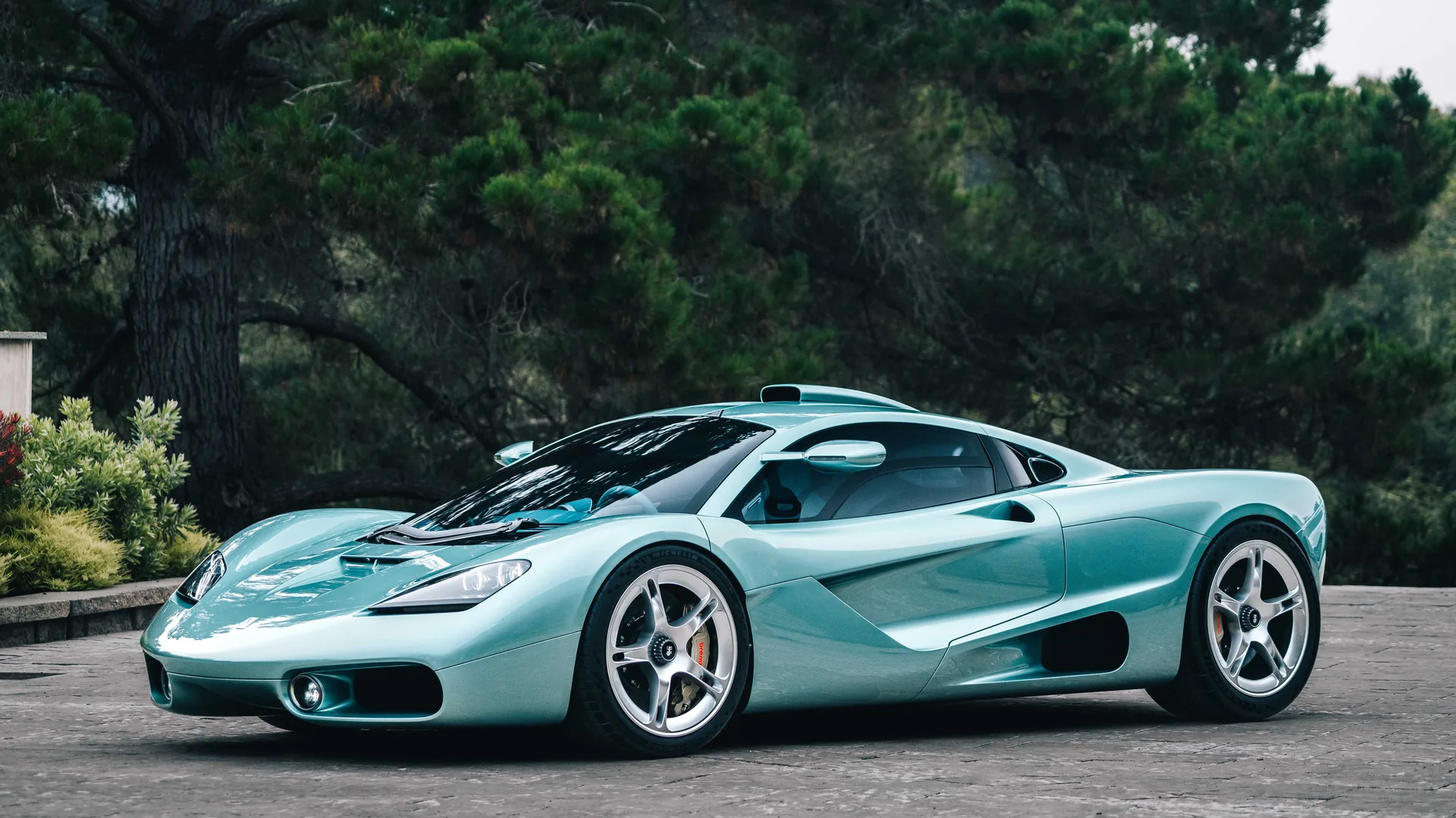
Third-party outlets have filled the vacuum with estimates — figures around 360 km/h and a sub-three-second 0–100 km/h time circulate widely — but none of these are confirmed by the manufacturer and none come from an instrumented test. Until De Tomaso releases data or an independent test is published, treat every P72 performance number you see as an estimate. For context on what a comparable manual car does claim, see the Gordon Murray S1 with its 681 hp manual V12 and the 800 hp Spyker C8 Preliator XXV.
No Screens, No Drive Modes, No Apologies
The cabin is where the P72 makes its boldest statement. There are no touchscreens and no infotainment system; the only display is the legally-required digital rearview mirror. Instead you get milled-aluminium switchgear with a copper finish, traditional analog dials, and a gloriously exposed manual shifter linkage that looks like jewellery. There are no selectable drive modes — instead, a pushrod suspension with three-way manually adjustable dampers lets the driver tune the car by hand. Even starting it is theatre: a leather key fob slots into the gear stick before the push-button start.
Carbon Craft Beneath the Curves
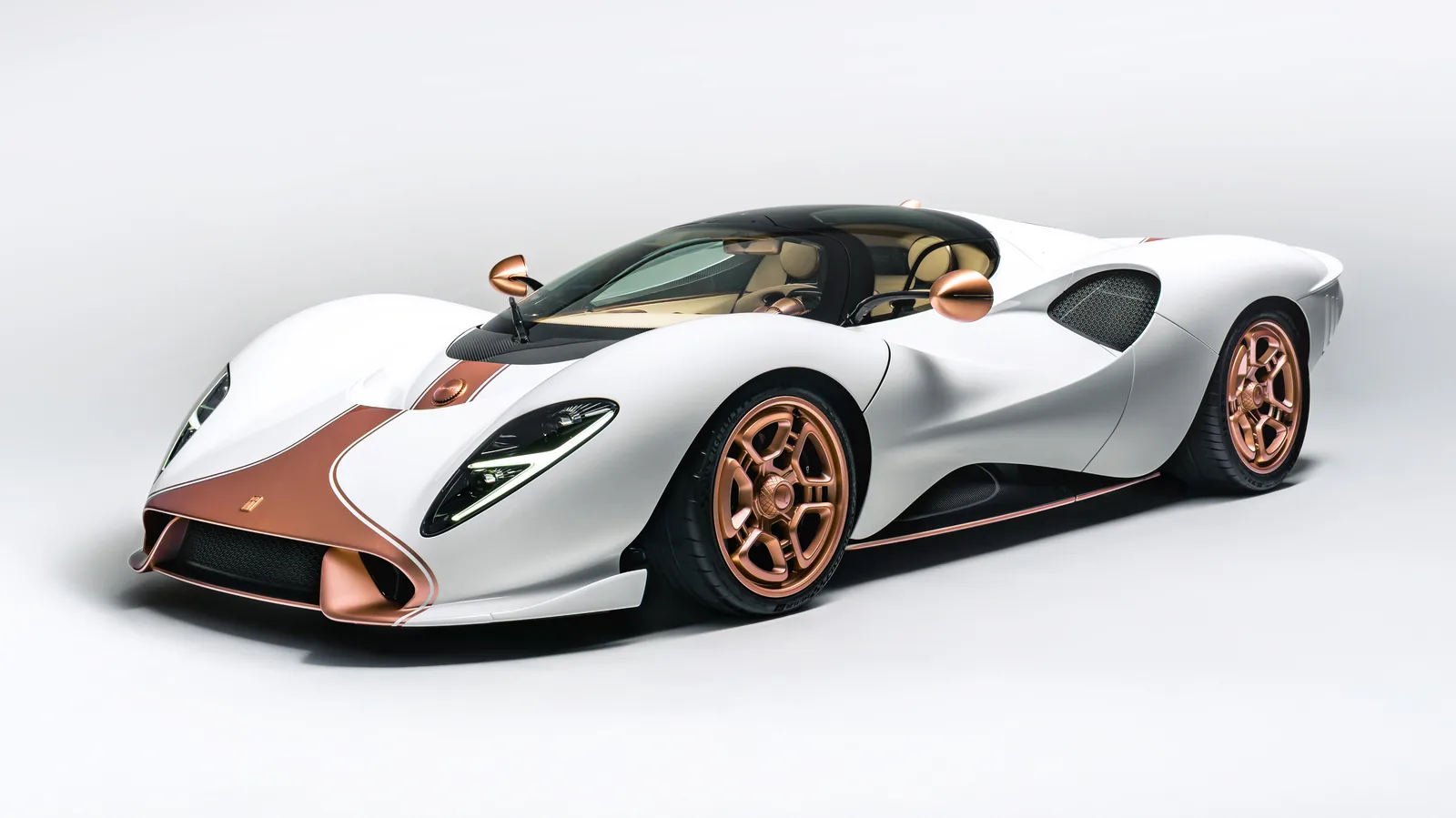
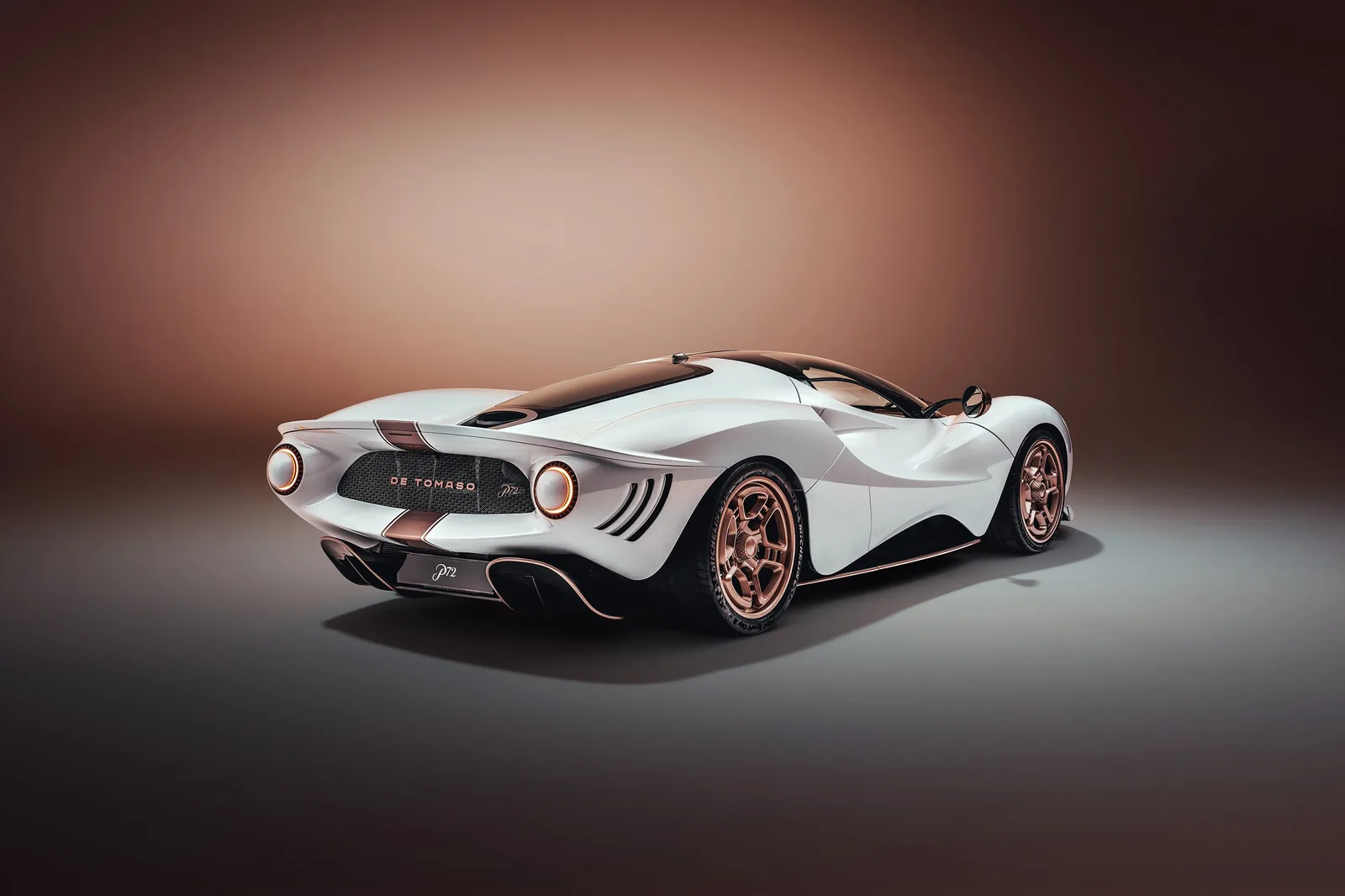
Underneath the swooping, 1960s-endurance-racer bodywork — every panel formed from carbon fibre — sits a carbon monocoque chassis. This is a point worth clarifying, because the 2019 concept was widely reported as using a tub derived from the Apollo Intensa Emozione. For the production car De Tomaso states something different: an all-new, clean-sheet carbon fibre chassis woven entirely in 4x4 twill, with the unibody monocoque formed from a single uninterrupted piece of carbon fibre and no bonded sections, and carbon extending outward from the central tub into the front and rear subframes. The body's flowing fenders, deep side intakes and top-exit exhausts are a direct homage to the one-off De Tomaso P70 of 1965, the stillborn racer co-developed by Alejandro De Tomaso and Carroll Shelby. The mid-mounted V8 sits low thanks to a dry-sump system, and the whole car is conceived as a grand tourer rather than a track weapon — note the generous 100-litre fuel tank for long-distance driving.
"It is tuned not for lap times, but for road-going rhythm and analogue connection." — De Tomaso
72 Cars, All Spoken For
True to its name, only 72 examples of the P72 will ever be built, each priced at around €1.6 million (roughly $1.8 million) and individually commissioned for its owner — whom De Tomaso calls a "custodian." Every slot sold out years ago, with a waiting list for any cancellations. Production, after a winding road through Italy, the USA and several German partners, finally settled at the brand's own facility in Affalterbach, Germany. The car shown at the May 2025 production reveal was an internal production-specification unit built outside the 72 custodian allocations, which is why it did not reduce the customer count.
For collectors, the P72 represents something increasingly rare: a brand-new supercar built around driver engagement instead of lap times, with the kind of provenance — a revived legendary marque founded in Modena in 1959 by Alejandro De Tomaso, a tiny run, a hand-built American V8 — that tends to age into serious value.
Can You Still Buy a De Tomaso P72?
Not from the factory. All 72 build slots were allocated before series production began, so De Tomaso holds no unsold cars and the order book is closed. The only realistic route to ownership is the secondary market: an existing custodian reselling either an unbuilt allocation or a finished car. Because deliveries only began in 2026, almost no cars have changed hands, and to date no P72 has appeared in a major public auction result — which means there is no established resale benchmark against the roughly €1.6 million list price.
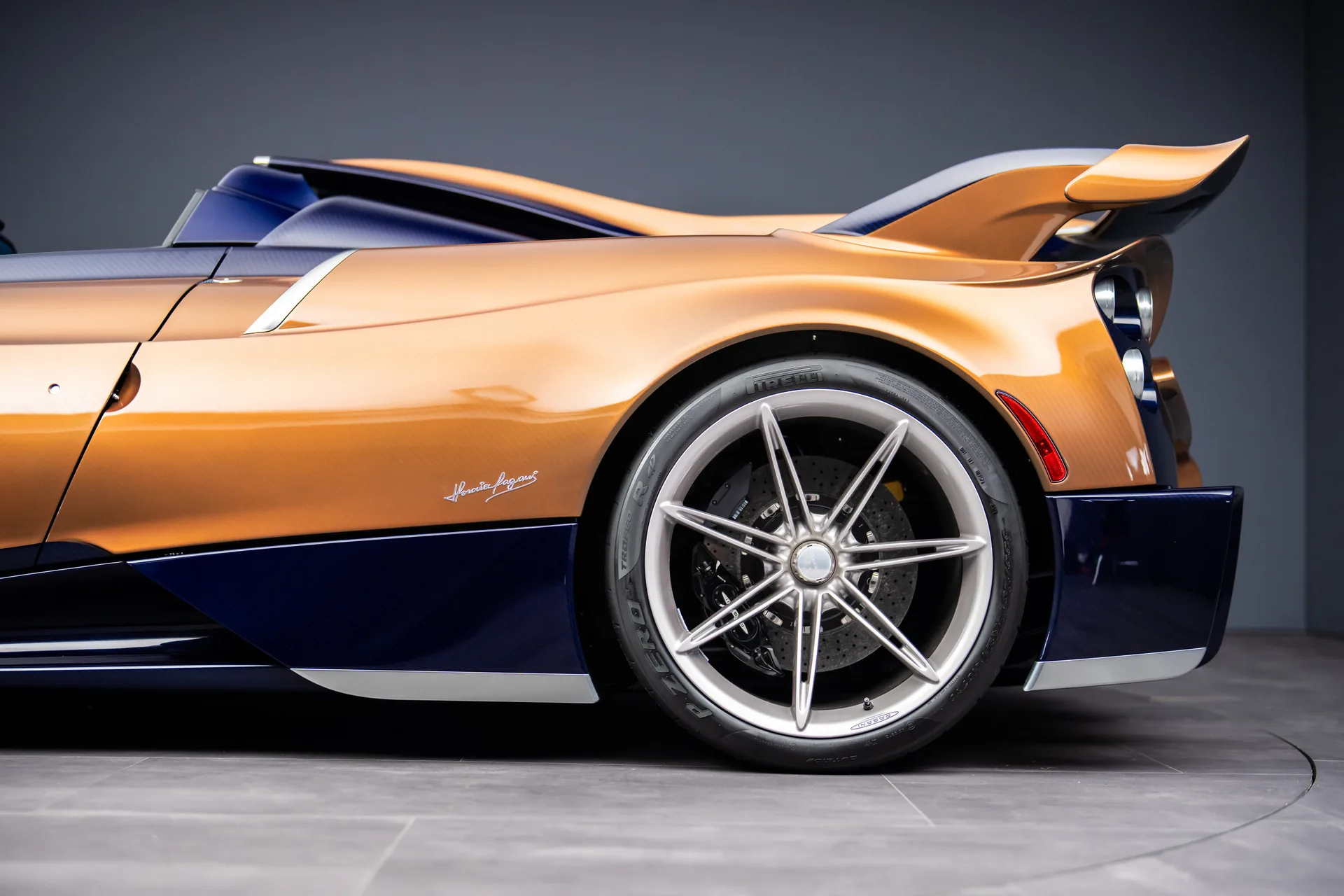
Practically, that leaves specialist brokers and private collector networks. Anyone hunting one should verify the car's internal designation, whether the allocation is a factory custodian slot or a resale, and the exact commission specification, since each of the 72 cars is individually configured and no two are identical. Comparable analog, low-volume alternatives that occasionally surface include the Pagani Huayra 70 Derecho manual V12 roadster, and you can browse the current selection on the Batman Garage for-sale listings.
What's Next: The P900 and Its 888 HP V12
The P72 is not the only car on De Tomaso's 'P' platform. The P900 is a track-only sibling, introduced in 2022 and limited to just 18 customers. In February 2026 the company detailed its powertrain, and it is a sharp contrast to the P72's supercharged V8: a naturally aspirated 7.0-litre, 65-degree V12 developed by ItalTecnica, producing 888 hp (662 kW / 900 PS) at around 9,500 rpm with a 10,200 rpm redline.
The engineering detail is unusually aggressive for a customer car. It uses an eight-stage dry-sump system, a billet aluminium crankcase, forged connecting rods, ultra-light pistons, two overhead camshafts per bank with four titanium valves per cylinder and a carbon fibre intake. The complete engine weighs under 200 kg (441 lb), and drives the rear wheels through a sequential Xtrac gearbox. An earlier plan for a Capricorn-built V12 revving to 12,300 rpm at 220 kg was dropped in favour of the ItalTecnica unit. De Tomaso has said visual and aerodynamic updates to the P900 will be revealed later in 2026.
Taken together, the P72 and P900 describe a marque that has chosen mechanical purity over specification-sheet escalation — one analog grand tourer with no screens and no quoted top speed, one track car with a bespoke high-revving V12. For more low-volume analog machinery, see the full Batman Garage car archive, or grab a desktop background from the free 4K car wallpaper collection.
The P72 belongs to the same analogue tradition as the Ferrari F40, built around a gated manual and a 478 hp twin-turbo V8, and the Mercedes-Benz SLR McLaren 722 Edition, a carbon-bodied grand tourer with a 650 hp supercharged AMG V8. Full technical guides to both are in the Legendary Cars archive.