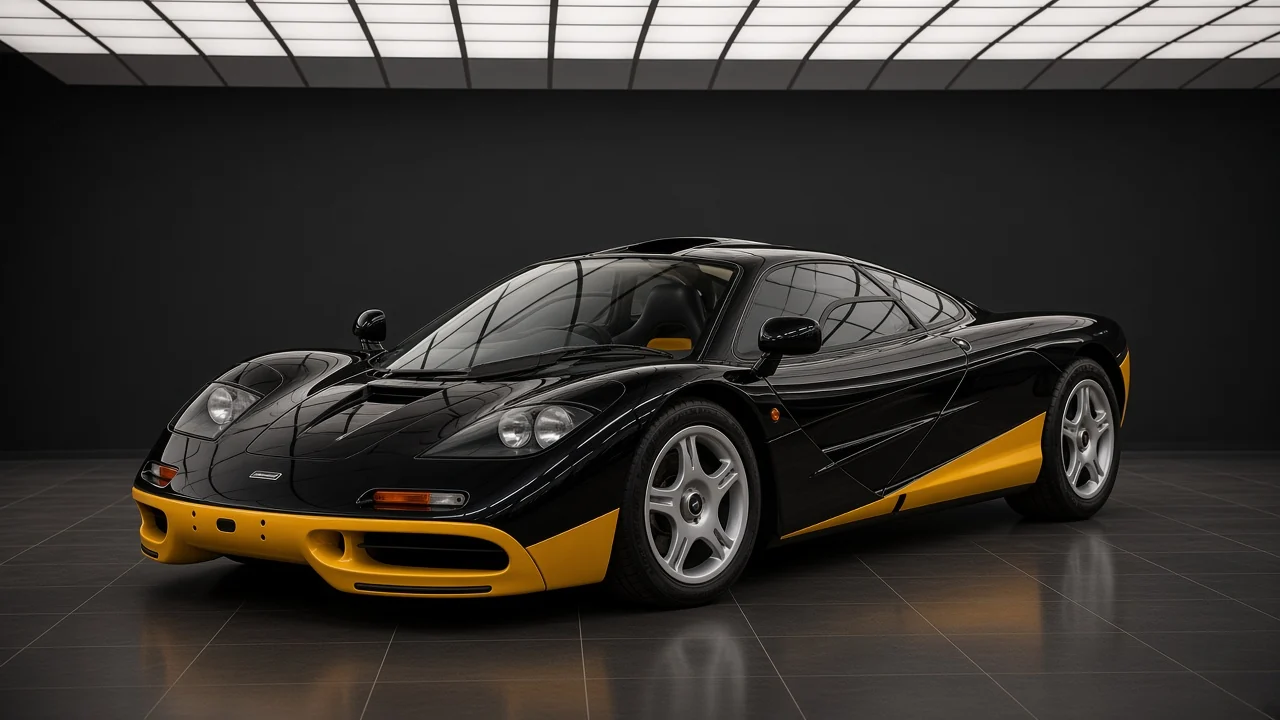
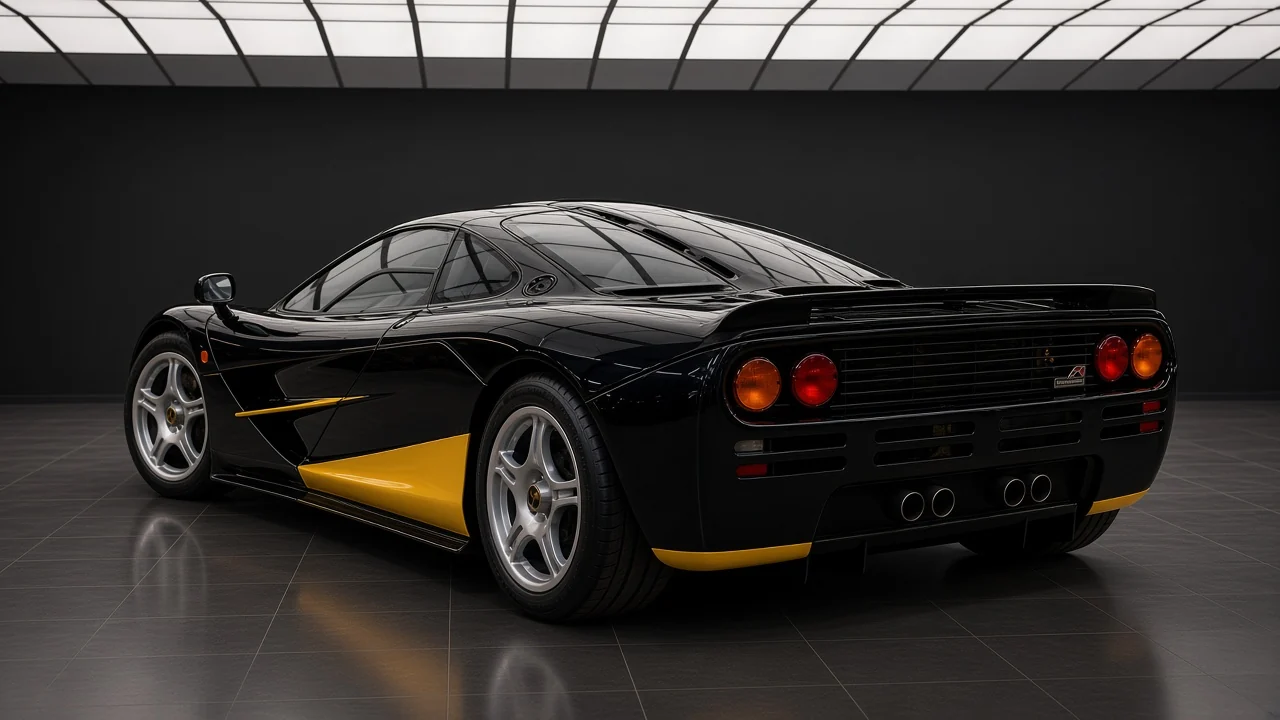
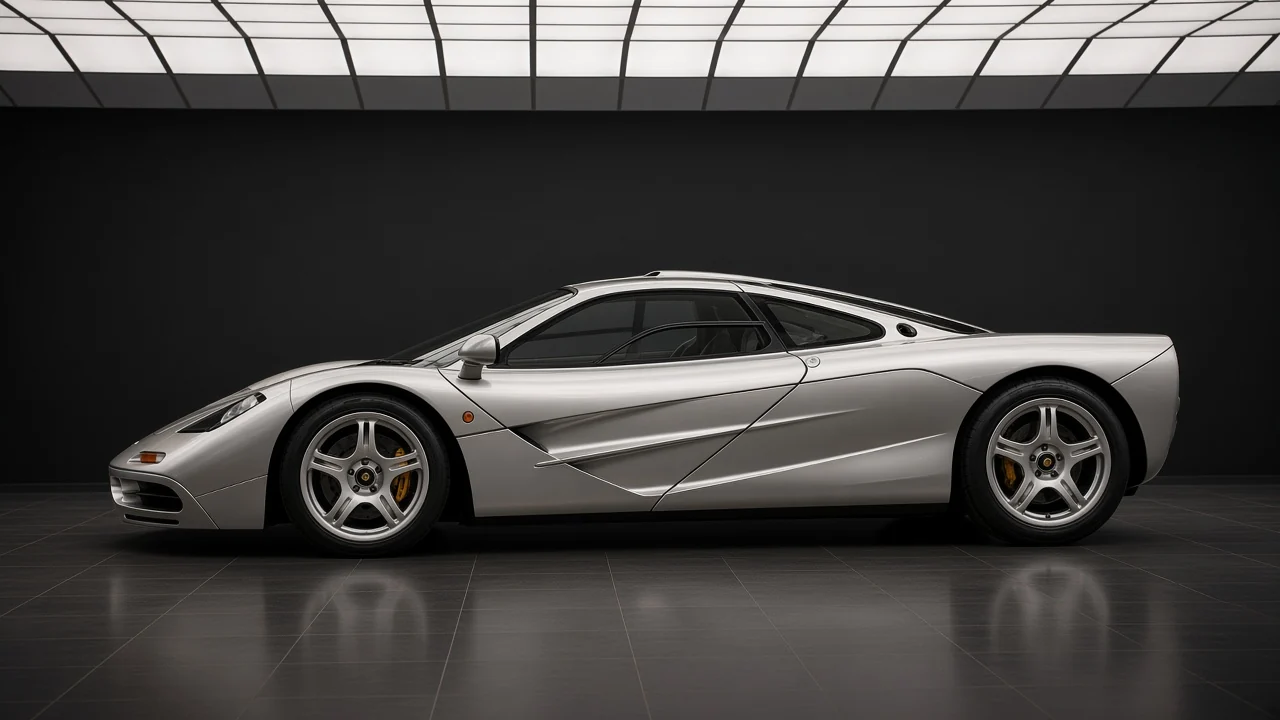
The McLaren F1 road car is the series model built from 1992 to 1998: a three-seat coupe, driver in the centre, no fixed rear wing. The BMW S70/2 6,064 cc V12 produces 627 PS (461 kW / 618 hp). With the rev limiter at 7,500 rpm, top speed is 372 km/h. McLaren built 64 of these standard road cars. The launch price was £540,000.
A car with a large fixed wing is not this model. That is an F1 LM or an F1 GTR. The 386 km/h figure is a 1998 run in the XP5 prototype with the limiter raised, not the showroom setting. The wider total of 106 adds prototypes, the LM, the GT and 28 race cars. The record the road car’s reputation still carries later passed to the Bugatti Veyron 16.4.
McLaren F1 Specifications
Figures below are for the standard series road car. The 7,500 rpm limiter is the showroom setting. The LM, the GT and the GTR are separate cars, and the 386 km/h run belongs to a prototype.
| Specification | McLaren F1 road car |
|---|---|
| Production | 1992–1998 |
| Designer | Gordon Murray (concept), Peter Stevens (body), Paul Rosche (engine) |
| Engine | BMW S70/2 6,064 cc naturally aspirated V12 |
| Power | 627 PS (461 kW / 618 hp) at 7,400 rpm |
| Torque | 650 Nm (479 lb-ft) at 5,600 rpm |
| Redline | 7,500 rpm |
| Gearbox | 6-speed manual, transverse, Weismann |
| Layout | Mid-engine, rear-wheel drive |
| Seats | 3, driver in the centre |
| 0–60 mph | 3.2 s (McLaren) |
| 0–100 mph | 6.3 s (McLaren) |
| Top speed | 372 km/h with the 7,500 rpm limiter |
| Dry weight | 1,140 kg |
| Kerb weight | About 1,138–1,140 kg dry; about 1,260 kg with fluids in period figures |
| Launch price | £540,000 |
| Series road cars | 64 |
How Many McLaren F1 Cars Were Made?
Count the cars in two layers, or the internet will keep arguing.
McLaren’s own production note, still on the company’s archived site, says production closed in May 1998 with 100 customer cars delivered: 64 F1 road cars, five F1 LM cars built after the 1995 Le Mans win, three F1 GT longtail road cars, and 28 F1 GTR race cars.
The wider manufacturing total is 106, because prototypes sit outside that customer list. The usual split is five XP prototypes, 64 road cars, one LM development car plus five LMs, one GT development car plus two customer GTs, and 28 GTRs. 64 + 5 + 3 + 28 is the 100. Add the development chassis and you reach 106.
If the question is “how many road cars can a collector buy?”, the honest answer is 64 standard F1s, plus five LMs and the small GT run. If the question is “how many exist?”, it is 106.
627 PS, and Why the Bay Is Lined in Gold
Gordon Murray asked BMW for a naturally aspirated V12 after Honda could not take the project. Paul Rosche’s motorsport group built the S70/2: 60 degrees, 6,064 cc, four valves per cylinder, individual throttle bodies, dry sump, 627 PS. It was more powerful than Murray’s first target, and heavier by a small margin. There is no turbo. The specific output was the point.
The carbon body could not live next to that exhaust heat, so the bay is lined with gold foil. About 16 grams per car. It is a heat reflector, not jewellery. The same engine family later ran, restricted, in the F1 GTR and, unrestricted, in the LM at 680 PS (500 kW). The LM is slower in a straight line than the road car — about 362 km/h — because the fixed wing adds drag.
372 km/h on the Limiter, 386 km/h in a Prototype
The series road car is limited to 7,500 rpm. At that limiter the top speed is 372 km/h. On 31 March 1998 Andy Wallace drove the five-year-old XP5 prototype at Ehra-Lessien with the limiter raised to 8,300 rpm. The two-way average was 240.1 mph (386 km/h). A one-way peak on the same run was about 391 km/h (243 mph). McLaren later printed 386 km/h on the specification sheet. Quote 372 km/h for a series car as delivered. Quote 386 km/h only for that prototype run.
The road car has no big fixed wing. Two small electric fans help the underbody. A driver can switch a high-downforce mode. The brief was a car you could use, which is why the standard suspension is softer than the LM or the GTR.
The Centre Seat, and the £540,000 Price
Murray’s sketch, from a delayed flight after the 1988 Italian Grand Prix, put the driver in the middle. Two passengers sit back and outboard. Luggage goes in side compartments. The doors swing up. It is a road car laid out like a Formula 1 cockpit that still takes two friends.
The order price was £540,000. McLaren did not get rich on the programme. Owners did. A standard road car sold in 2021 for $16.55 million. Hagerty’s guide has, in recent years, put road cars well into eight figures in sterling. Treat any “current price” you see in a headline as a market print, not a sticker. Chassis, kilometres, and whether the car is a standard F1, an LM, or a later LM-spec conversion (chassis 018 and 073 were upgraded) change the number completely.
F1, LM, GT, GTR — Do Not Mix Them
The road F1 is the one in the table above. The F1 LM is five customer cars in Papaya Orange (two more were finished in the black and stripes of the Le Mans winner for the Sultan of Brunei), 680 PS, a large fixed wing, and less straight-line speed. The F1 GT is the longtail road car, built so the 1997 GTR could be homologated — three in McLaren’s customer count. The GTR is the race car: 28 of them, and the 1995 Le Mans winner.
A later McLaren with the F1’s name on a badge is not this car. The P1 and the W1 are different programmes. The closest spiritual follow-up Murray himself drew is the GMA T.50, not a Woking hybrid.
Batman Garage Collector Verdict
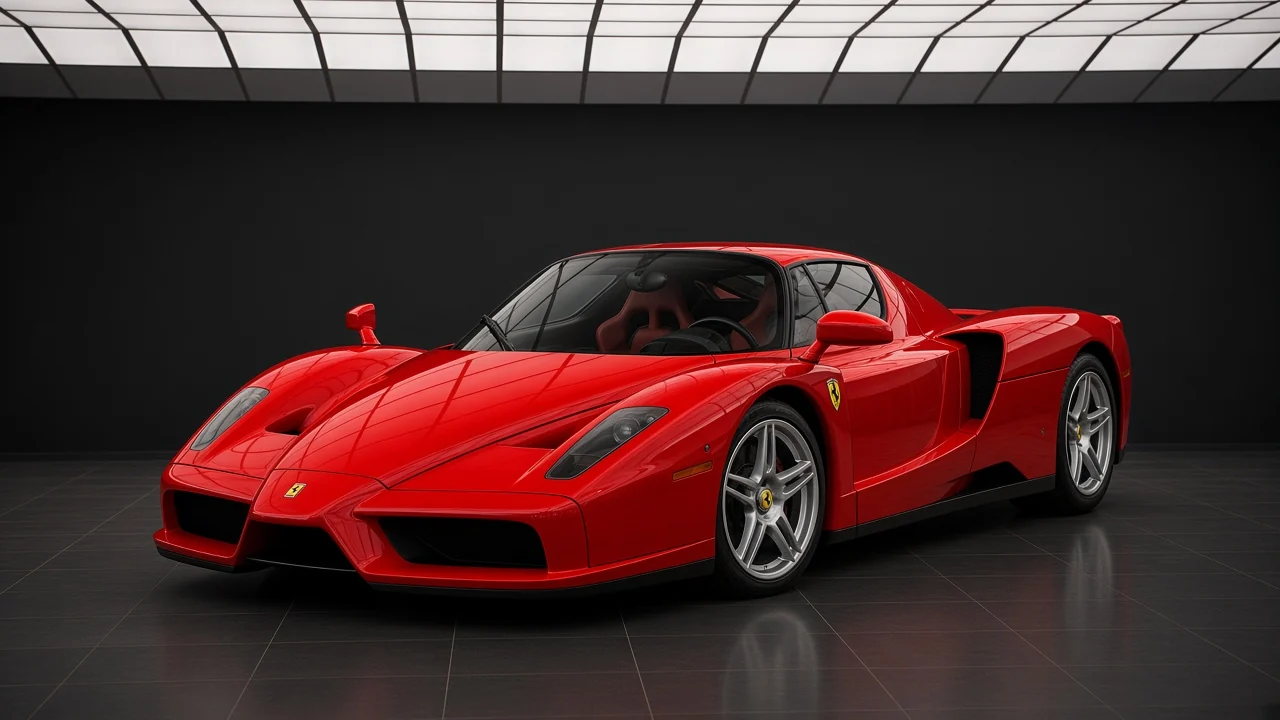
The series F1 is the reference naturally aspirated road car: central seat, 627 PS, 372 km/h on the limiter, and 64 of them. Ask which of the 106 a listing actually is before you ask what it is worth. A wing means it is not the road car on this page. The speed run people still quote later passed, in the history books, to the Veyron 16.4. The closest car in this garage’s other guides is the Ferrari Enzo.
Sources
- McLaren Automotive specification sheet — 627 PS, 3.2 s to 60 mph
- McLaren Automotive production note — 64 standard road cars inside the wider total
- McLaren F1, Czech Wikipedia — series car 372 km/h on the limiter; 391 km/h one-way only with the limiter raised; 64 road cars
- Andy Wallace, Ehra-Lessien, 31 March 1998 — XP5 prototype, 240.1 mph two-way average
- Period McLaren order paperwork quoting a £540,000 price
Frequently Asked Questions
How many McLaren F1 road cars were built?
64 standard series road cars were built between 1992 and 1998. The wider total is 106, which adds the prototypes, five F1 LMs, the F1 GT run and 28 F1 GTR race cars. The road car on this page is the 64, with no fixed rear wing.
What is the McLaren F1 horsepower?
The series road car’s BMW S70/2 6,064 cc V12 produces 627 PS (461 kW / 618 hp) at 7,400 rpm and 650 Nm at 5,600 rpm. The F1 LM is a separate car, rated at 680 PS, and it is not the series model.
What is the McLaren F1 top speed?
With the road car’s 7,500 rpm rev limiter, top speed is 372 km/h. On 31 March 1998 Andy Wallace recorded a two-way average of 240.1 mph (386 km/h) in the XP5 prototype at Ehra-Lessien, with the limiter raised to 8,300 rpm. A one-way peak on that run was about 391 km/h. That run is not the limiter setting of a series road car.
What was the original McLaren F1 price?
The launch price was £540,000 before options. Road cars have since sold publicly above $15 million. A 2021 sale of a standard road car reached $16.55 million. That is auction history, not a current asking price.
How many seats does the McLaren F1 have?
Three. The driver sits in the centre. Two passenger seats are set slightly behind, one on each side. Gordon Murray wanted the driving position of a single-seater without giving up the ability to take two people.
What engine is in the McLaren F1?
A bespoke BMW S70/2 naturally aspirated 6.1-litre V12, designed under Paul Rosche at BMW M. It is not a tuned production saloon engine. The engine bay is lined with gold foil as a heat shield — about 16 grams per car.