Forget everything you know about how cars are made. In a warehouse in Los Angeles called Area 21, a father-and-son team is building one of the most extreme hypercars on the planet — using technology that sounds like it belongs in a Batman movie. The Czinger 21C is a 1,250 horsepower hybrid hypercar with 3D-printed bones, a fighter-jet cockpit, and a habit of destroying lap records wherever it goes.
Pronounced "zinger," the car is the brainchild of Kevin and Lukas Czinger, who spent a decade and nearly $1 billion developing a revolutionary manufacturing process through their parent company, Divergent Technologies. The same company that builds 3D-printed components for Bugatti, McLaren, and SpaceX decided to build its own car — and the result is unlike anything else on the road.
Built Like a Fighter Jet
Climb under the massive dihedral door — it stretches three feet above the roofline — and you drop into a central driving seat straight out of an F-16. Your passenger sits directly behind you in tandem, like a weapons officer in a fighter jet. The only other modern hypercar built around a central driving position is the Gordon Murray S1, and it seats its two passengers alongside the driver in the McLaren F1 tradition rather than behind. There is no rearview mirror because you would just be looking at your own passenger. There are no cupholders. No radio dial. Just a butterfly steering wheel, shift lights, and the raw, overwhelming sensation of sitting inside a machine designed for one purpose: absolute speed.
The cockpit is a carbon-fiber tub, the front and rear subframes are 3D-printed, and over 600 pounds of the car's total mass consists of additively manufactured components — skeletal, organic structures that look like they were grown rather than engineered. Czinger used artificial intelligence as an evolutionary algorithm, feeding in stress loads and aerodynamic requirements to generate shapes that use the absolute minimum material while exceeding every safety standard.
The Powertrain: Controlled Chaos
Behind the seats sits a bespoke 2.9-liter twin-turbocharged V8 that revs to a screaming 11,000 rpm and produces 750 horsepower on its own. Two 268 hp electric motors drive the front wheels through an 800-volt system, fed by a 4.2 kWh battery split between the side sills. A third motor on the crankshaft acts as both a starter and a generator, harvesting energy to keep the battery charged.
Total combined output: 1,250 horsepower and 691 lb-ft of torque. The Blackbird edition — limited to just 4 units — pushes that to 1,350 hp on 101-octane fuel. Power reaches the rear wheels through an Xtrac 7-speed sequential gearbox housed in a 3D-printed casing. The result is 0–60 mph in 1.9 seconds, 0–124 mph in 4.8 seconds, and a quarter-mile time in the mid-eight-second range — quicker than anything Car and Driver has ever tested.
The Record Breaker
In 2025, Czinger did something no hypercar manufacturer has ever attempted. Over five consecutive days, the 21C set production-car lap records at five different circuits across California — Thunderhill, Sonoma, Laguna Seca, Willow Springs, and Thermal Club — and they drove the car on public roads between each track. The Laguna Seca record now stands at a staggering 1:22.30, obliterating the previous mark. The car also holds the Circuit of the Americas production-car record and the Goodwood Festival of Speed hillclimb record for production cars.
"It represents a tipping point to a new way of engineering, a new way of manufacturing." — Lukas Czinger, CEO
Three Variants, 80 Total
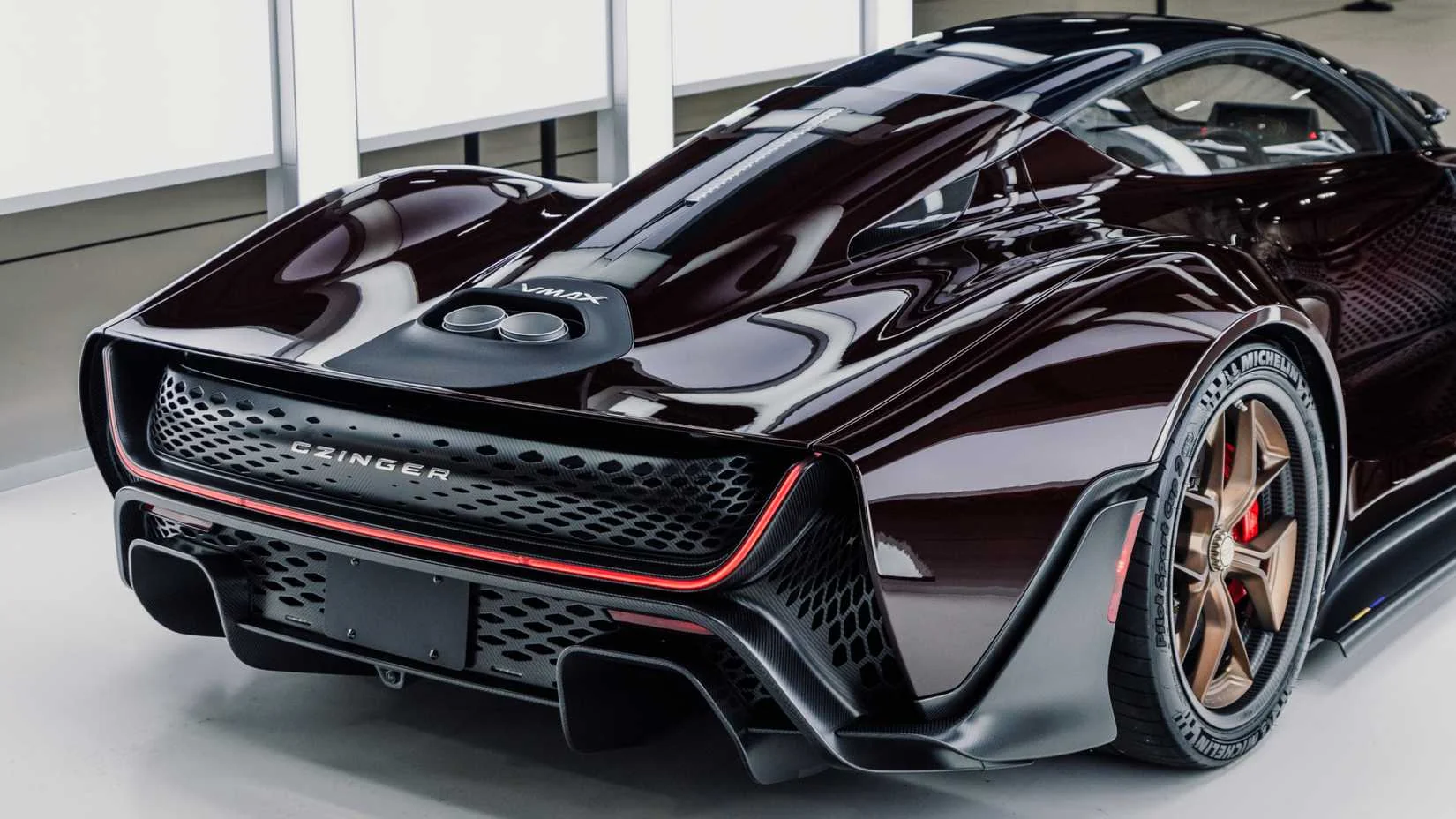
Czinger offers three configurations. The standard 21C wears a massive rear wing for maximum downforce — over 2,000 kg at 200 mph. The 21C V Max removes the wing and extends the rear bodywork for a claimed 253 mph top speed. And the 21C Blackbird, an homage to the Lockheed SR-71, gets unique black paint and the 1,350 hp engine tune. Most cars transact between $2.7 and $2.8 million after options, which include a $230,000 visible carbon-fiber exterior and $40,000 carbon-fiber wheels.
Only 80 units will ever be built. Each takes approximately 800 hours to assemble across 12 stations in Area 21. Despite being a first car from a new manufacturer, build quality rivals the best in the business — with paint quality, carbon-fiber alignment, and attention to detail that surpasses many established marques.
The Batman Garage Verdict
A hypercar with 3D-printed skeleton, tandem fighter-jet seating, an 11,000 rpm V8, and AI-designed suspension components that look like they were extracted from an alien spacecraft. If this doesn't belong in the Batcave, nothing does. Bruce Wayne would have one on order before the press conference ended — probably the Blackbird edition, naturally.
The Czinger 21C proves that the future of the hypercar isn't just about horsepower numbers — a lesson the Mercedes-AMG One teaches from the opposite direction, using a Formula 1 power unit to chase lap times rather than headline outputs. It's about rethinking how cars are designed and built from the ground up. Divergent Technologies has quietly built a billion-dollar manufacturing revolution, and the 21C is its most brutal calling card. The Dark Knight approves.