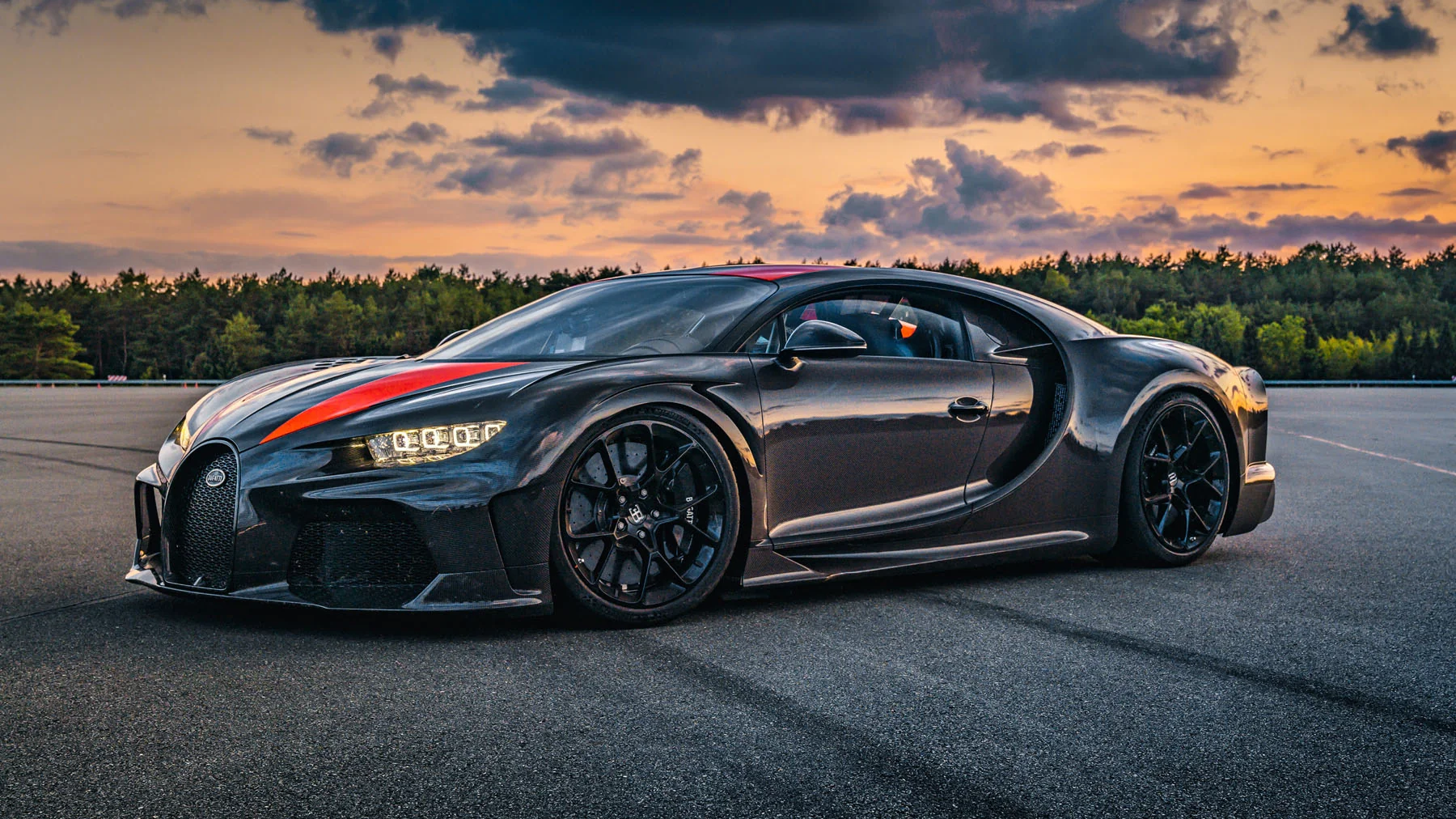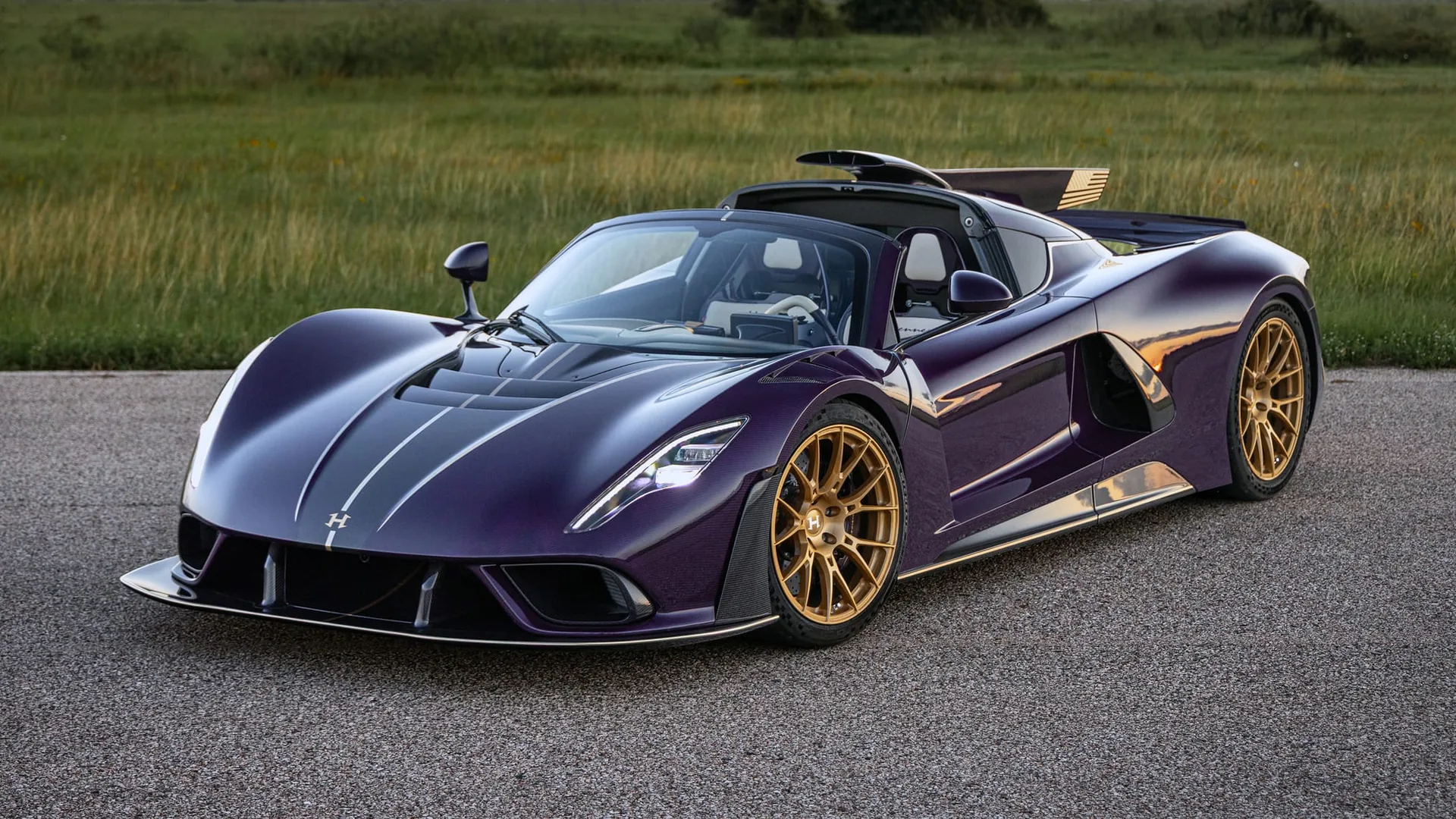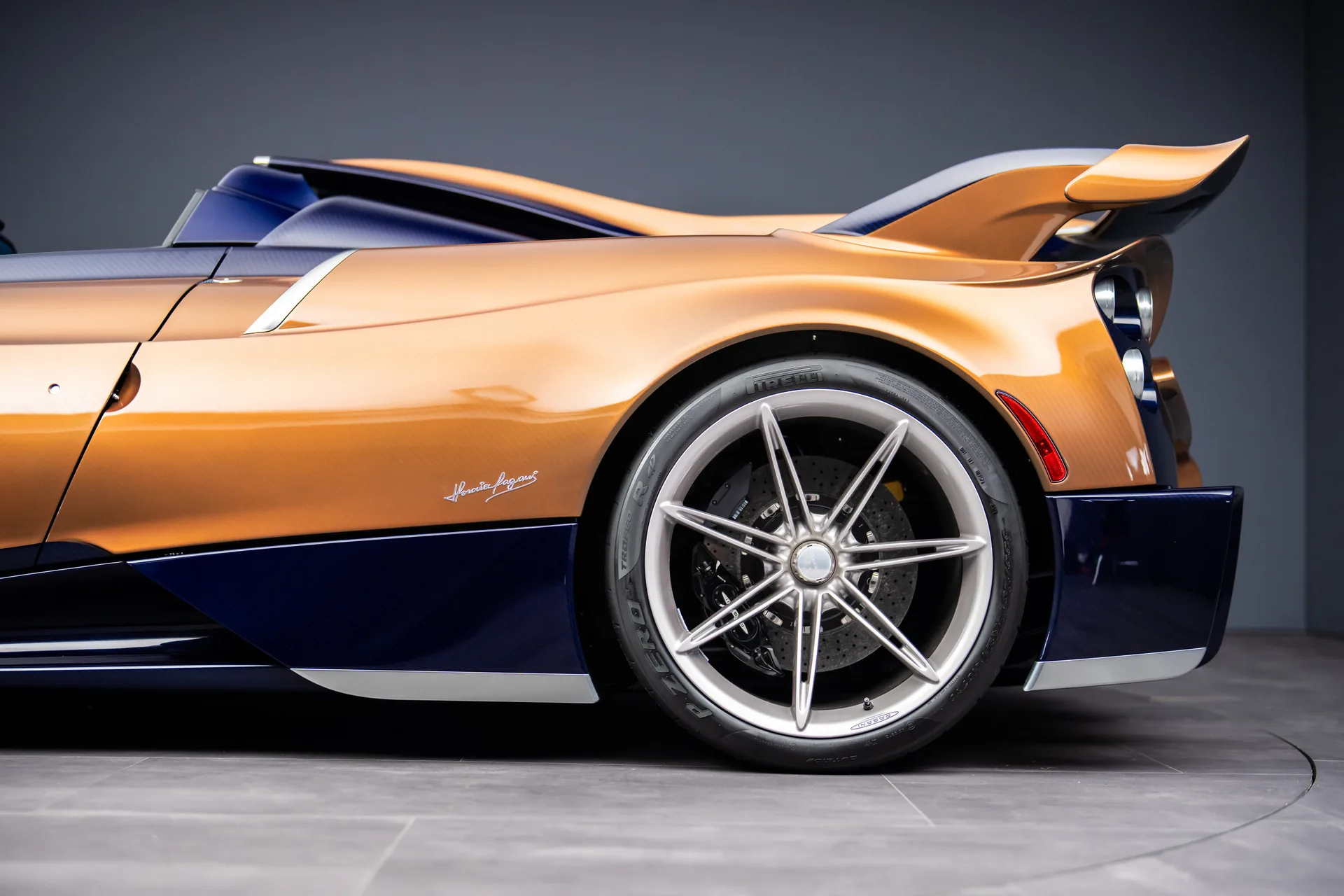
BUGATTI DESTRIER — KEY FIGURES
Top speed 236 mph (380 km/h) · 1,600 PS W16 · 1,406 kg curb · price undisclosed (est. $20–30M)
Bugatti pulled the covers off the Destrier today, 6 August 2026, ahead of its public premiere at the Pebble Beach Concours d’Elegance on 16 August 2026. The car is the third creation from Bugatti’s Programme Solitaire — the Molsheim brand’s ultra-exclusive one-of-one commissioning arm — following the Brouillard (based on the Mistral, revealed 2024) and the F.K.P. Hommage (based on the Chiron, revealed 2025).
What sets the Destrier apart from every previous Solitaire commission is its foundation: instead of the Chiron road-car platform, its engineers have reskinned the extreme, track-only Bugatti Bolide. That means a Dallara-developed carbon-fibre monocoque, no dedicated aerodynamic add-ons, and — underneath the sculpted bodywork — the Bolide’s complete 1,600 PS (1,578 hp) quad-turbocharged 8.0-litre W16 powertrain, one of the last examples of Bugatti’s legendary sixteen-cylinder engine before the era of the Tourbillon V16 begins in earnest.
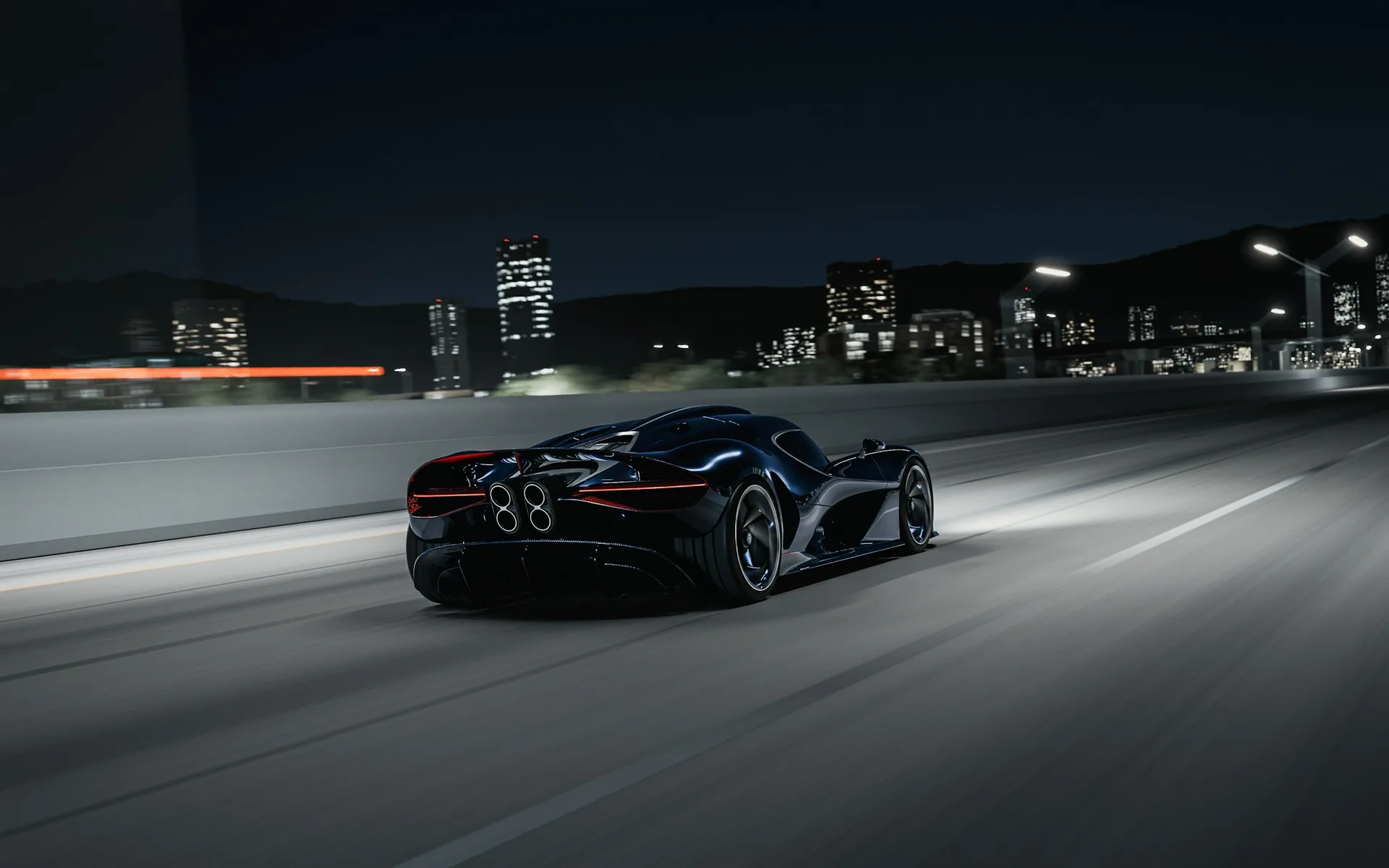
Bolide DNA — Same Carbon Tub, Same 1,600 PS W16, No Wings
Bugatti built 40 examples of the Bolide, completing the final car in November 2025. The Bolide is the most extreme W16 Bugatti ever produced: a track-only, high-downforce weapon developed to extract every last drop from the 8.0-litre engine, with a curb weight of just 3,100 lb (1,406 kg) and a claimed top speed of 236 mph. The Destrier keeps that Dallara-developed carbon-fibre monocoque and the complete quad-turbo W16, paired with the familiar seven-speed dual-clutch gearbox and all-wheel drive from the current Bugatti hardware set. Power remains 1,600 PS (1,578 hp).
Bugatti has not published performance figures for the Destrier, which is unusual. Instead, the manufacturer’s press release frames the W16 as a background detail: “offered almost in passing”, and states that the car’s story is one of “proportion and craftsmanship, not outright performance.” What Bugatti has confirmed is that this is a fully engineered vehicle that goes through the same testing and homologation regimen as its series-production cars, with the Solitaire team indicating it is intended to be road-legal once development is complete.
One Metre Tall — Lower Than a Ford GT40, With 20 & 21-Inch Wheels

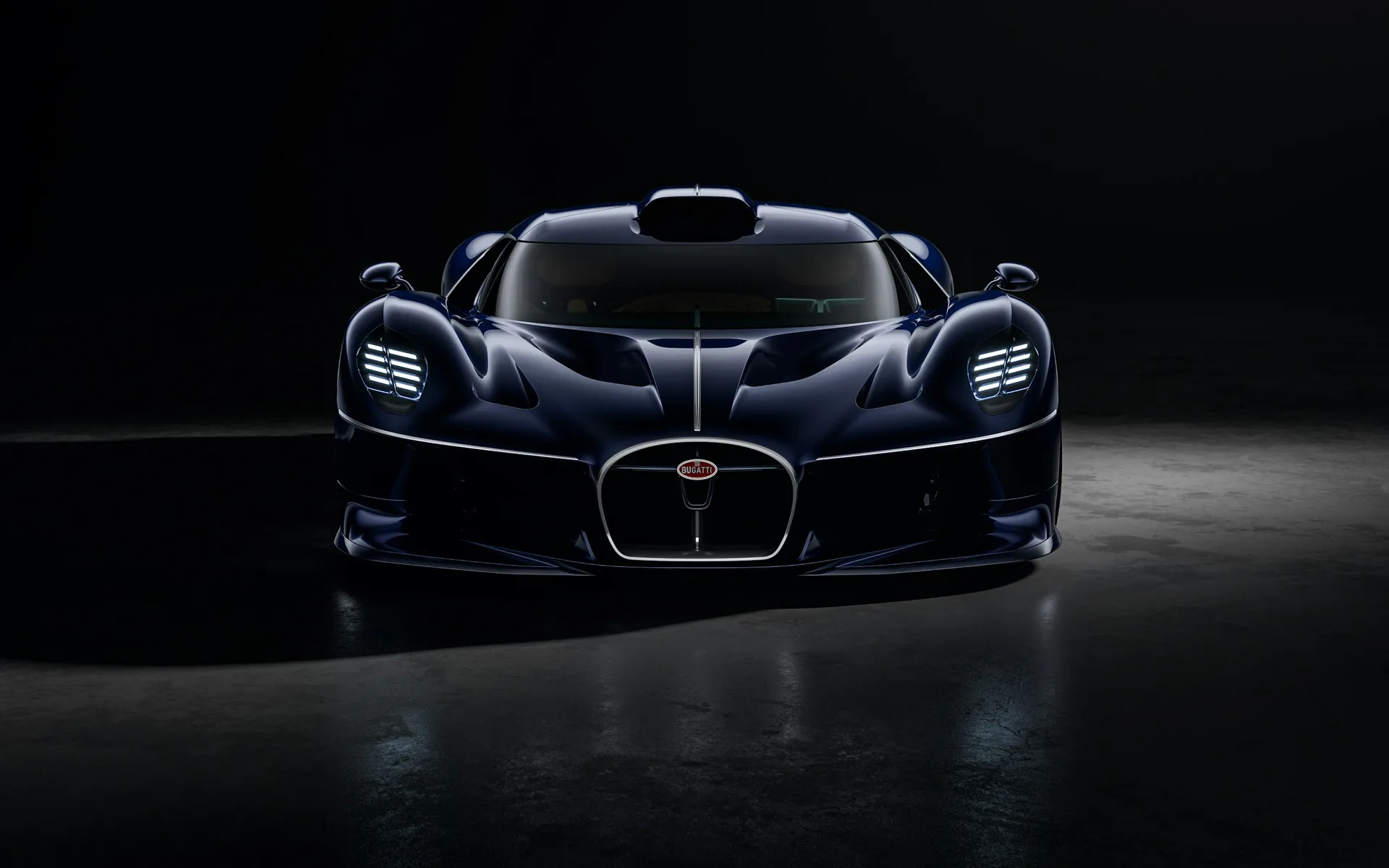
The Destrier stands just 1,000 mm (39.4 inches) tall — a whole 16 mm lower than the original 1966 Ford GT40, whose 40-inch height gave the Le Mans-winner its name. That makes it the lowest Bugatti ever built, edging out even the Bolide it’s based on. Bugatti has swapped the Bolide’s 18-inch motorsport-spec wheels for a bespoke 20-inch front and 21-inch rear forged design, wrapped in road-going tyres rather than slicks — another strong signal that the Destrier is intended for public roads.
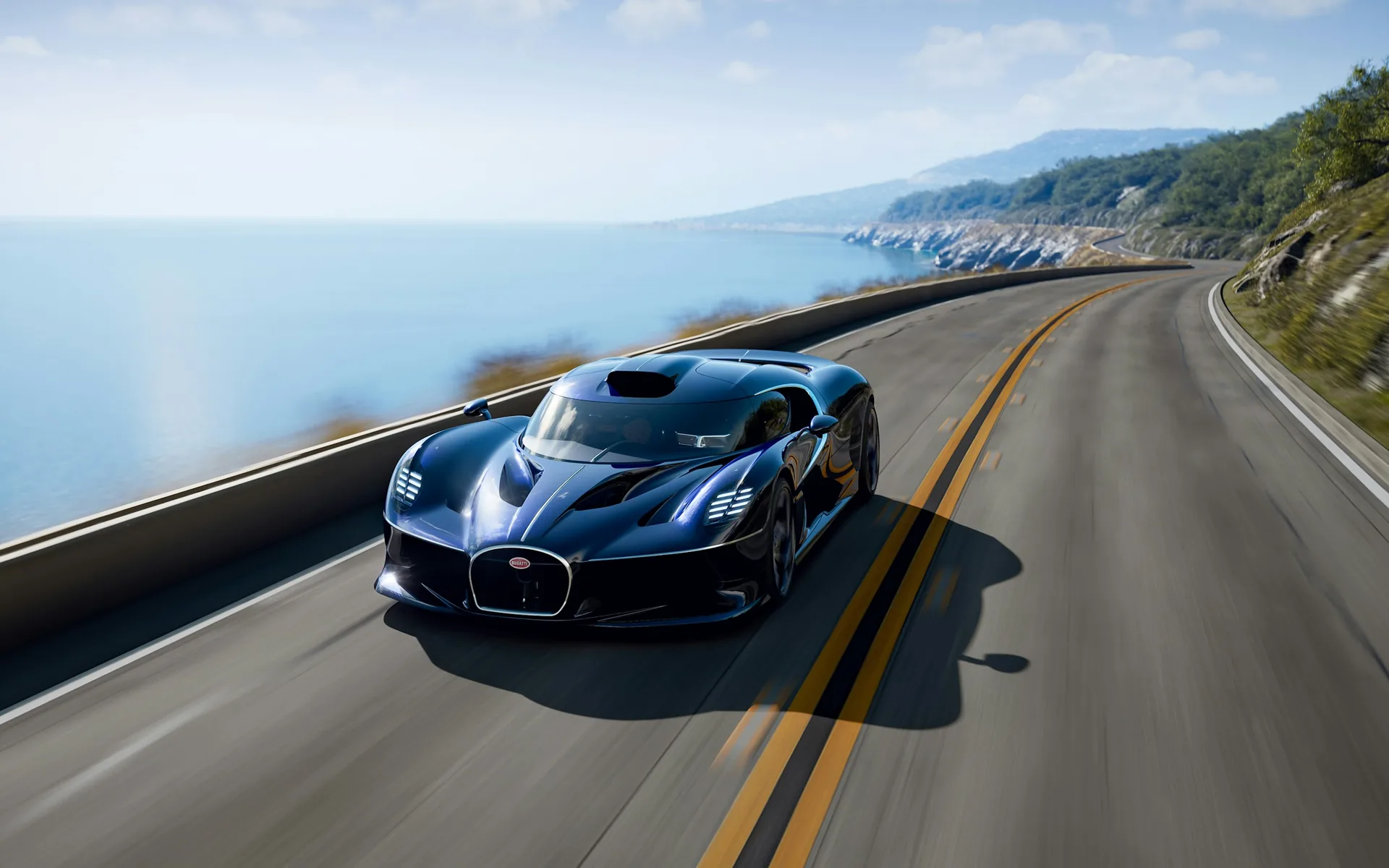
The exterior surface is intentionally clean. There is no fixed rear wing, no visible splitter, and none of the aerodynamic canards, fins or louvres that define the Bolide. The Destrier retains Bolide-derived intakes, ducting and cooling hardware in more subtle locations, so the powertrain still breathes properly, but the visual composition is dominated by a single wave-like line that runs uninterrupted from the front horseshoe grille all the way to the rear. A roof-mounted air intake feeds the W16, and a large tinted-carbon rear deck sits above a body-coloured diffuser and quad-tip central exhaust.
Sapphire Celeste — A Type 57SC Atlantic Homage With Diamond Sparkle
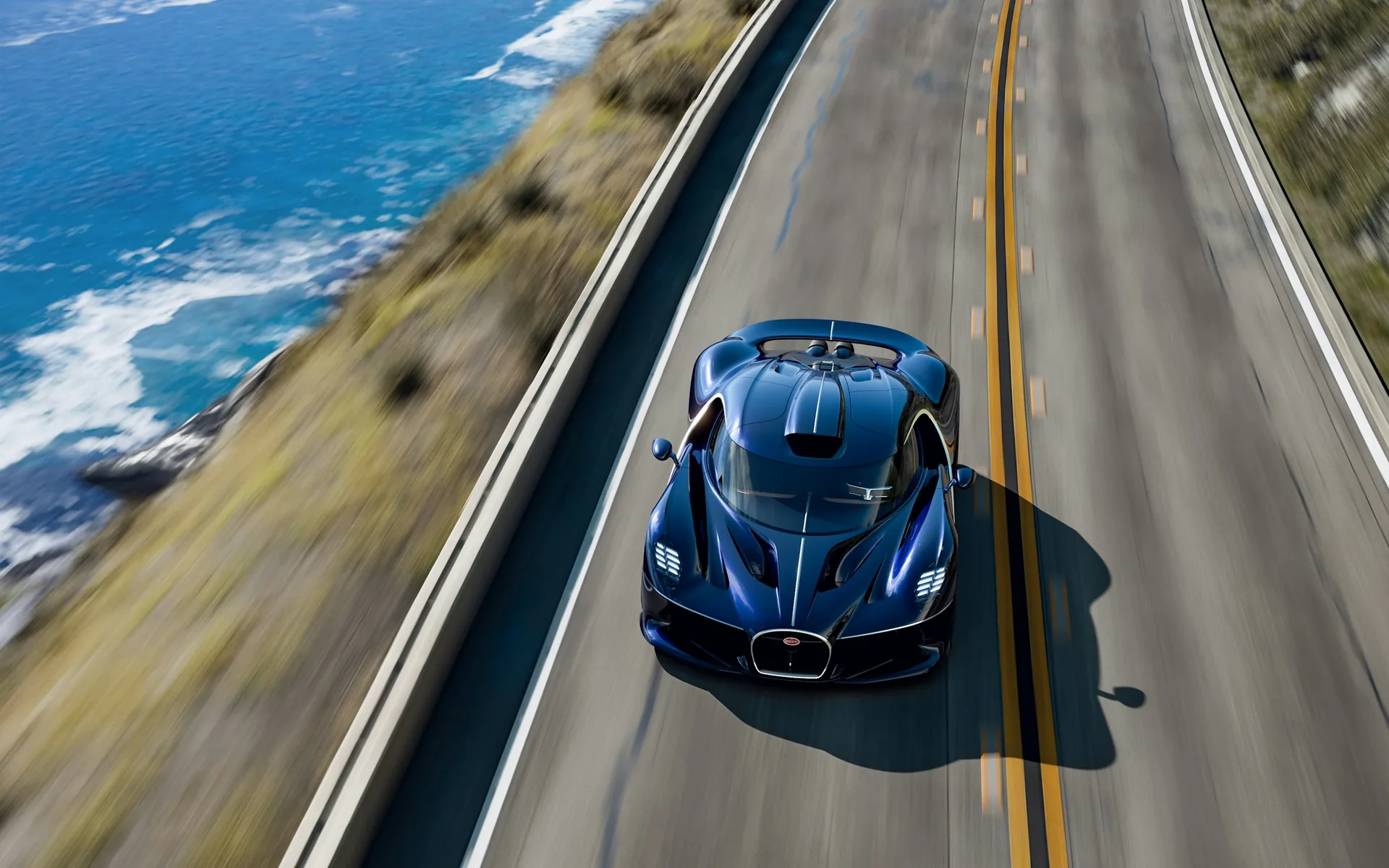
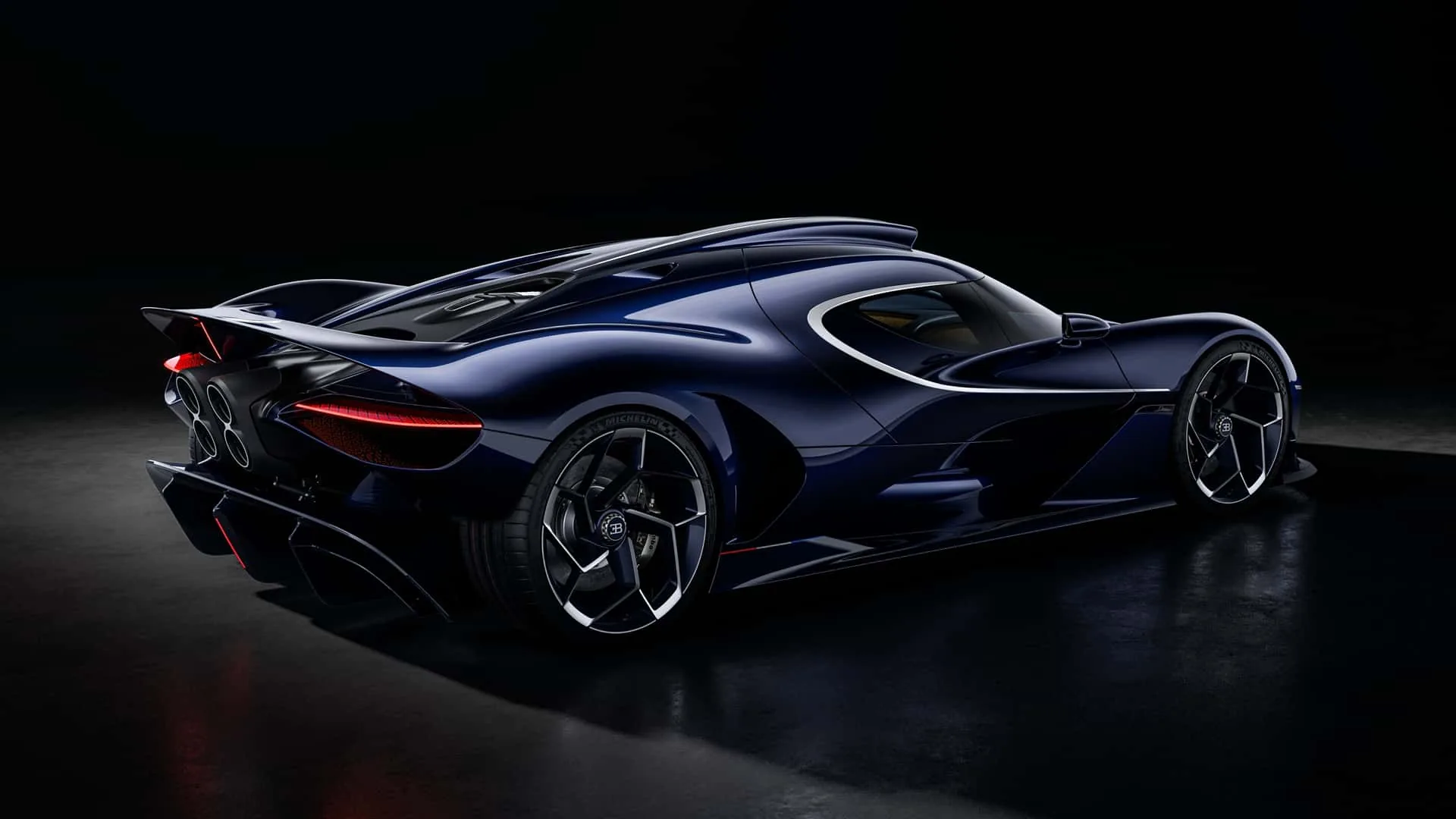
The exterior colour is a bespoke shade called Sapphire Celeste, developed specifically for the Destrier and its private commissioning owner. Bugatti describes it as a deep, multi-layered blue with diamond-inspired sparkle engineered into the paint’s structure — the finish behaves differently depending on the lighting, from an almost black darkness under studio lights to a shimmering, faceted blue in daylight.
Sapphire Celeste is a direct homage to the Bugatti Type 57SC Atlantic, chassis 57591 — one of only four Atlantics ever built and today owned by American designer Ralph Lauren. Chassis 57591 originally wore a very similar deep blue before being repainted black. Bugatti has completed the historical reference with a plate above the windshield that carries hand-laser-engraved miniatures of the Le Mans-winning Type 57G Tank and the Type 57SC Atlantic. Polished aluminium accents and tinted, body-coloured carbon-fibre panels complete the exterior palette.
Ambre Voyageur Cabin — Copper Halo Textile, Hammered Aluminium Armour
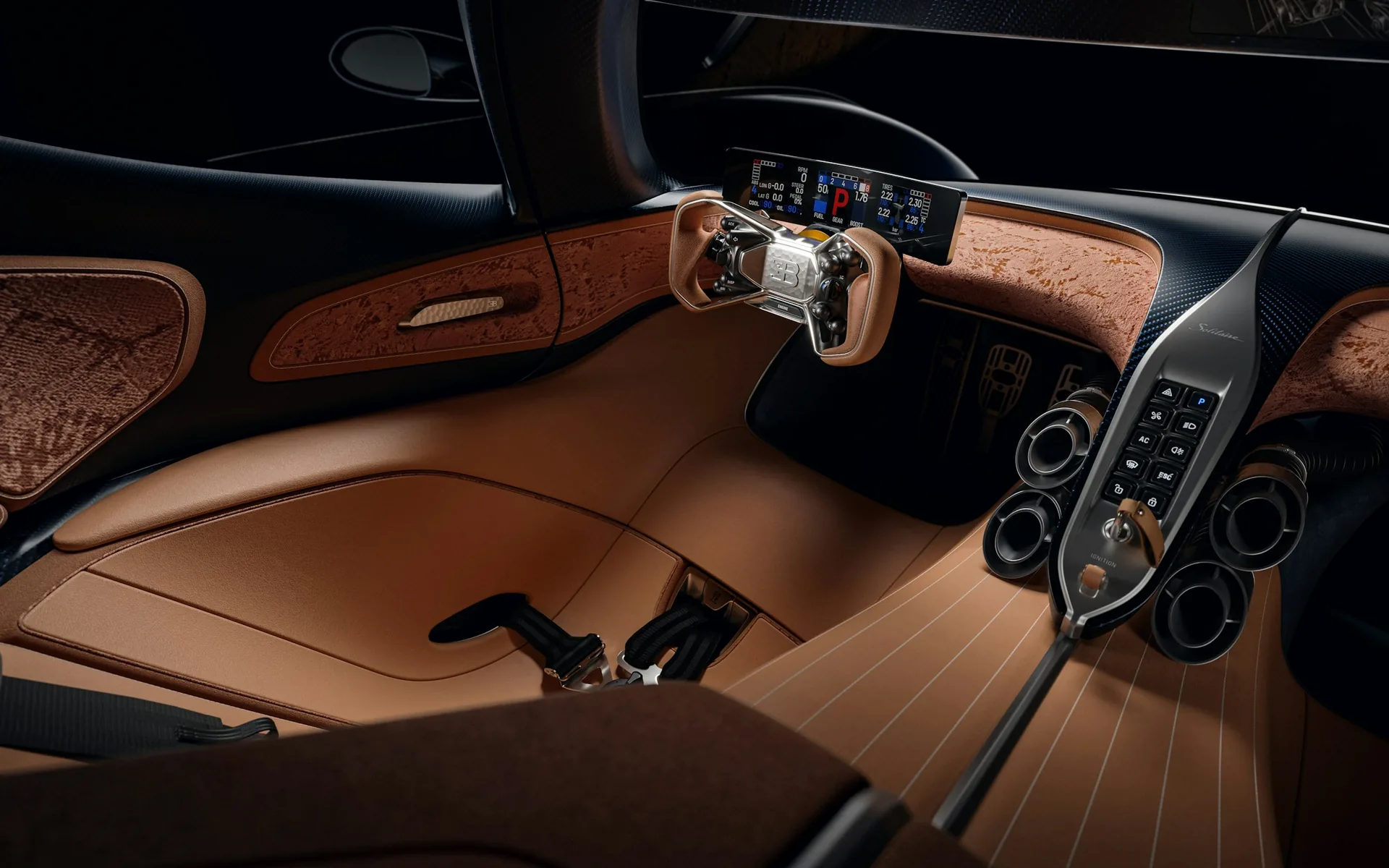
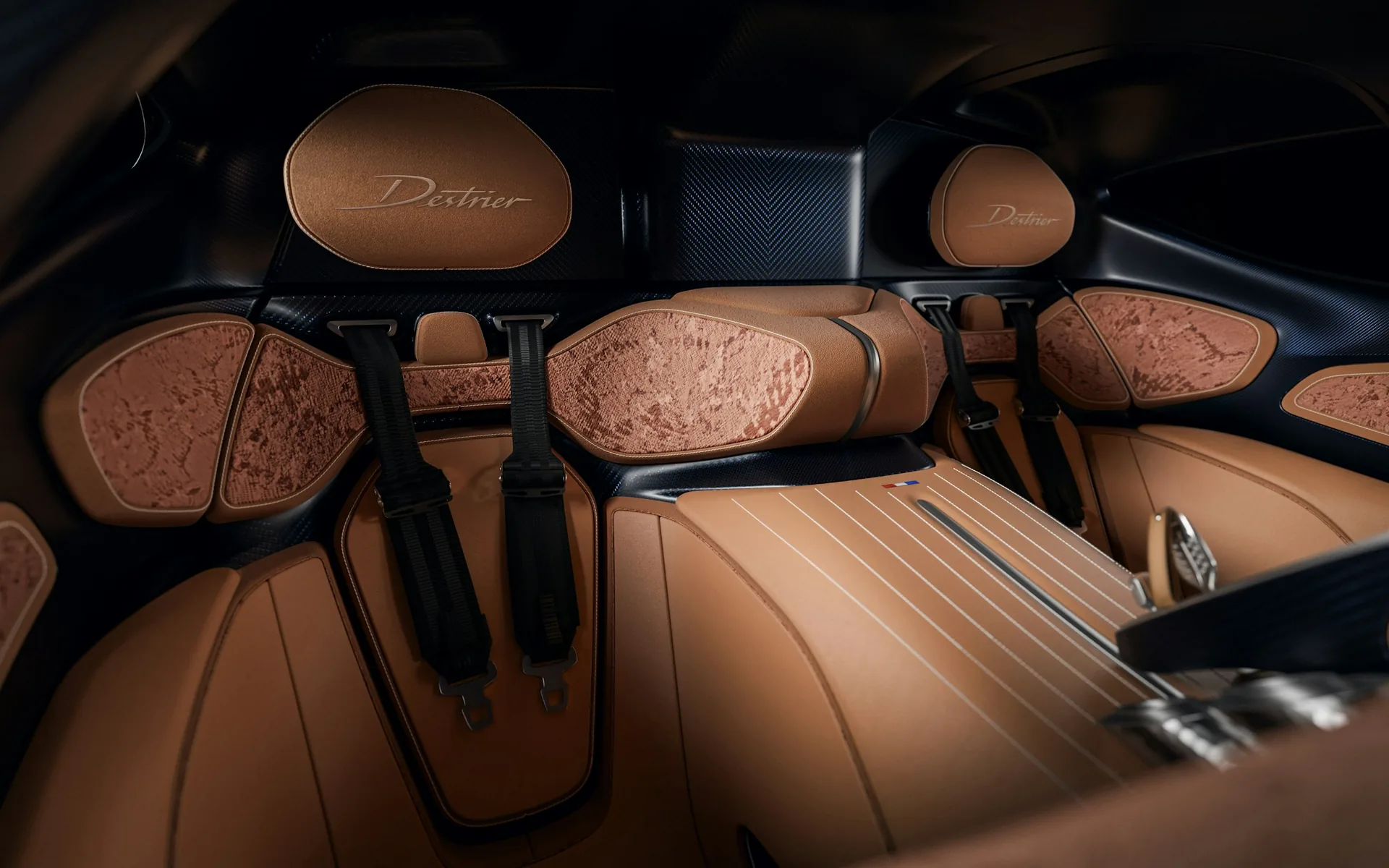
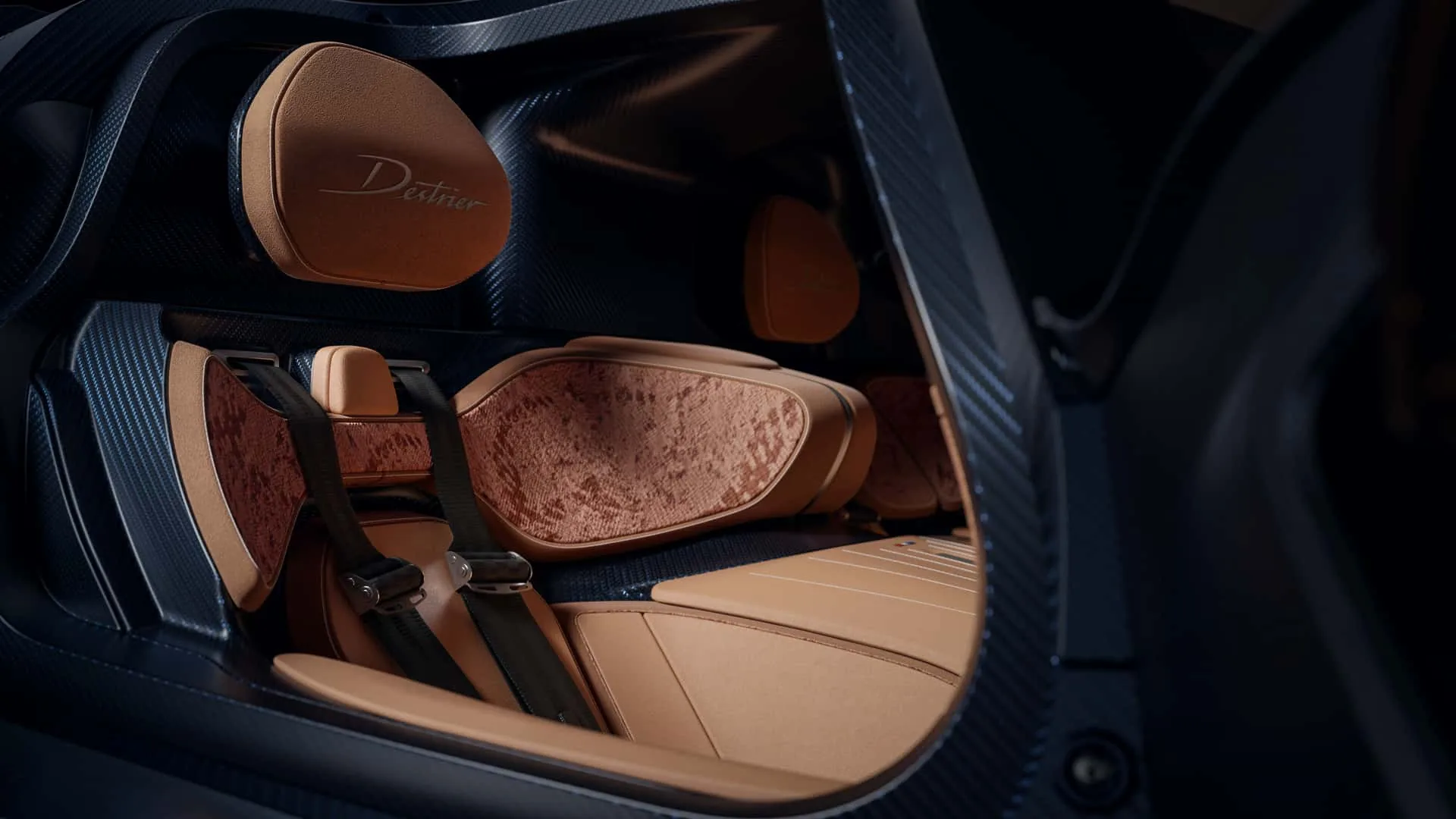
Inside, the Destrier trades the Bolide’s stripped-down cockpit for the most elaborate interior ever produced by the Solitaire team. The trim is called Ambre Voyageur — a warm brown palette combining full-grain leather and nubuck, split with a bespoke 3D-knitted textile featuring copper yarn woven in a circular “halo-line” pattern across sections of the seats and dashboard. The driver’s space keeps the Bolide-derived yoke-style steering wheel and its curved race-car digital instrument display, but almost every touchpoint has been re-crafted in a more refined material.
The medieval-knight-warhorse reference behind the Destrier name shows up throughout the cabin in a series of hammered aluminium accents — a finishing technique that intentionally recalls the beaten surface of a knight’s armour. The steering-wheel hub, door handles, air vents and door-entry plates are all executed in this hand-hammered aluminium, sitting against the tinted carbon monocoque tub which remains visible in structural areas. Air conditioning is retained — another detail carried across from the Bolide, which was one of the very few track-only specials in the world to have factory-fit HVAC.
Spec Table — Destrier vs Bolide vs Solitaire Predecessors
| Specification | Bugatti Destrier (2026) | Bugatti Bolide (2024) | Solitaire Brouillard / F.K.P. Hommage |
|---|---|---|---|
| Base Car | Bolide monocoque (Dallara-built) | Bespoke carbon tub | Mistral (Brouillard) / Chiron (F.K.P.) |
| Engine | 8.0L quad-turbo W16 | 8.0L quad-turbo W16 | 8.0L quad-turbo W16 |
| Power | 1,600 PS (1,578 hp) | 1,600 PS (1,578 hp) | Up to 1,600 PS |
| Drivetrain | AWD, 7-speed DCT | AWD, 7-speed DCT | AWD, 7-speed DCT |
| Height | 1,000 mm (39.4 in) — lowest Bugatti ever | ~1,016 mm (40 in) | Chiron/Mistral standard height |
| Wheels | 20″ front / 21″ rear bespoke | 18″ motorsport-spec, both ends | 20″ front / 21″ rear |
| Body | Wingless carbon sculpture | Full active-aero, big wing | Neo-classical GT bodies |
| Exterior Colour | Sapphire Celeste (diamond-sparkle multi-layer blue) | Bugatti two-tone black/racing colours | Bespoke per owner |
| Interior | Ambre Voyageur leather + copper halo textile | Stripped track cockpit | Full-luxury bespoke cabin |
| Homologation | Intended road-legal | Track-only, not homologated | Fully road-legal |
| Production Volume | 1 of 1 | 40 units | 1 of 1 (each) |
| Estimated Price | “Well into eight figures” (est. $20–30M) | €4.0M / $5.0M | Est. €20–28M each |
Price, Owner & Delivery Window
Bugatti has not disclosed a price for the Destrier, and it’s standard practice with Solitaire commissions that the identity of the owner is kept private. Coverage from Jalopnik and Evo places the expected commissioning cost “well into eight figures”, with earlier Solitaire cars — the Brouillard and F.K.P. Hommage — understood to have traded between €20 million and €28 million each. Given the Destrier’s Bolide underpinnings and the additional engineering work required to make a track-only carbon tub road-compliant, the actual figure is expected to sit at the upper end of that band, or above it.
The car is a completed reveal, but the physical example will require another one to two years of testing and homologation before it’s delivered. Bugatti has confirmed that every Solitaire creation goes through the same durability, crash, emissions and performance validation as its series-production models — there are no shortcuts on paperwork just because only one car is being built.
Public Debut — The Quail on 15 August, Pebble Beach on 16 August
The Destrier will make its first public appearances during Monterey Car Week 2026:
- The Quail, A Motorsports Gathering — Friday, 15 August 2026
- Pebble Beach Concours d’Elegance — Sunday, 16 August 2026
Bugatti’s decision to reveal the Destrier ahead of Monterey rather than at Pebble Beach itself is unusual — both the Brouillard and F.K.P. Hommage were first shown to journalists at Villa d’Este, not California. It reflects the growing importance of the U.S. as Bugatti’s single largest market, and hints that the Destrier’s commissioning owner is likely based in North America.
Verdict — The W16’s Farewell Tour Just Got Its Concours Piece
The Destrier arrives at an inflection point for Bugatti. The 99-unit W16 Mistral run ended in 2025, the 40-unit Bolide is complete, and the Tourbillon V16 hybrid programme is now inaugurating La Manufacture in Molsheim. What that leaves for the last of the W16 is exactly what the Destrier represents: Solitaire commissions built to order, at eight-figure sums, for a small circle of the world’s most invested Bugatti collectors.
Where the Brouillard leaned neo-classical and the F.K.P. Hommage leaned motorsport, the Destrier leans concours-piece sculptural. It’s the closest a modern Bugatti has come to something like La Voiture Noire — a car built to be looked at first, driven second — while still keeping the full 1,600 PS of the quad-turbo W16 on tap in case its owner ever chooses to remind everyone what’s under it.
Sources & Verification
Technical facts, historical references (Type 57SC Atlantic chassis 57591, Ralph Lauren ownership) and Monterey Car Week timing verified against: Bugatti Newsroom official press release — The Bugatti Destrier: A Sculpture of Speed, Motor1 Bugatti Destrier reveal coverage (6 August 2026), Jalopnik one-off Bugatti Destrier deep-dive, Evo Bugatti Destrier reveal, Top Gear Bugatti Destrier reveal, Road & Track Bugatti Destrier feature, and Car and Driver Bugatti Destrier reveal. Price estimates and testing timeline are industry projections; Bugatti has not published a figure.
Related Reading on Batman Garage
Frequently Asked Questions
How much does the Bugatti Destrier cost?
Bugatti has described the Destrier’s price as “well into eight figures.” Independent estimates place it in the US$20–30 million range, in line with previous Solitaire commissions such as the Brouillard and F.K.P. Hommage. Exact terms remain private between Bugatti and the commissioning owner.
How many Bugatti Destrier units will be produced?
The Bugatti Destrier is a one-off Solitaire commission. Only a single unit will ever be built, making it the third car in the Solitaire programme after the Brouillard (2024) and the F.K.P. Hommage (2025).
What engine powers the Bugatti Destrier?
The Destrier uses the 8.0-litre quad-turbocharged W16 in its 1,600 PS (1,578 hp) Bolide track-car specification. This is the most powerful naturally-aspirated-feel W16 output Bugatti has homologated, and the Destrier is the first Solitaire to use the Bolide platform rather than the Chiron road-car platform.
When was the Bugatti Destrier revealed?
Bugatti revealed the Destrier on 6 August 2026, ahead of Monterey Car Week, rather than at Pebble Beach itself. The unusual timing mirrors the reveals of the Brouillard and F.K.P. Hommage, which were also first shown to journalists at Villa d’Este and Molsheim respectively.
Is the Bugatti Destrier road legal?
No. The Destrier is not intended for public roads. Its Bolide-derived architecture, 1-metre overall height, and lack of full road-car crash and emissions homologation confine it to private circuits and closed events.
What does the name “Destrier” mean?
A destrier is the medieval war horse ridden by knights, prized for its strength, speed and stature. The name continues Bugatti’s tradition of evocative titles for one-off cars and matches the Solitaire’s bespoke, aristocratic positioning.
How is the Destrier different from the Chiron and Bolide?
The Destrier is built on the Bolide’s ultra-lightweight, track-focused carbon architecture rather than the Chiron road-car platform. It shares the Bolide’s 1,600 PS engine calibration and low ride height, but adds one-off bodywork, a bespoke Ambre Voyageur interior and Sapphire Celeste paint developed uniquely for its owner.
Where does the Destrier fit in Bugatti’s current line-up?
It sits alongside the Tourbillon V16 hybrid, the outgoing Chiron and Mistral W16 models, and the earlier Solitaires. The Destrier bridges the closing chapter of the W16 era with the coach-built future Bugatti is signalling through its Solitaire programme.