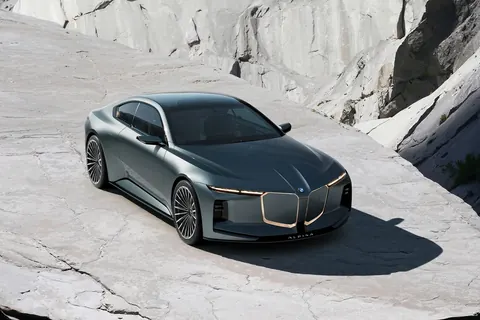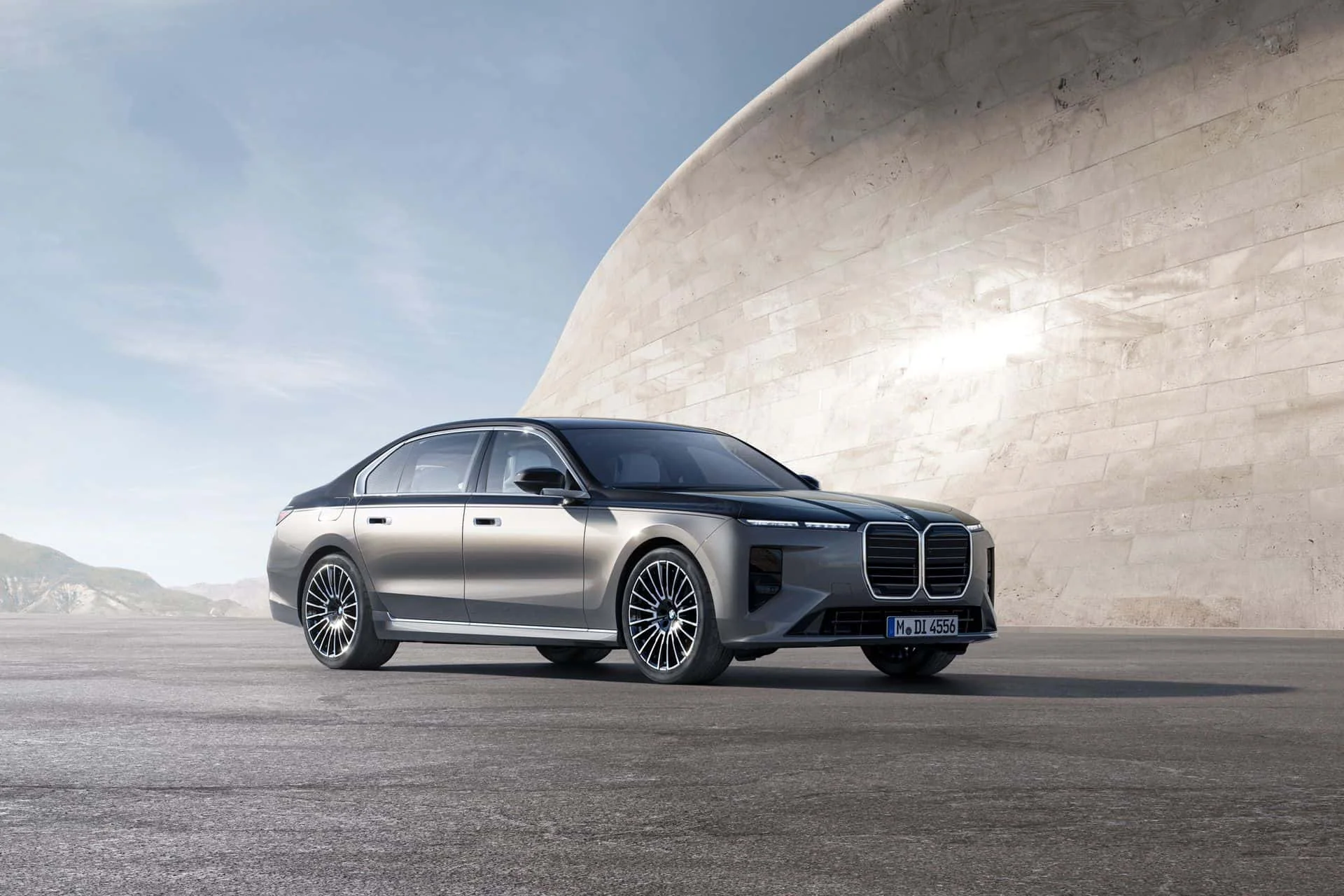
It was supposed to be a simple mid-cycle facelift. A new grille here, a refreshed bumper there, maybe a bigger screen inside. Instead, on the eve of the 2026 Beijing Auto Show, BMW tore up the script. The 2027 7 Series is not just updated — it is the first current-generation Bimmer to adopt the brand's Neue Klasse interior philosophy, bringing with it an infotainment revolution, a pillar-to-pillar windscreen projection, and, for the first time ever in a 7 Series, a dedicated 14.6-inch screen for the passenger.
And the fully electric i7, co-developed with Rimac, now delivers up to 728 km WLTP range with charging speeds bumped to 250 kW. Oh — and a proper, non-hybrid V8 M Performance is confirmed for 2027. Against expectations, Munich is building its most complete flagship in decades.
Exterior: Cleaner, Sharper, Finally Cohesive
The most divisive 7 Series of the modern era has been recalibrated. The controversial split headlights remain, but they are now vertical, stacked modules rather than horizontal — a decision that instantly makes the front end feel more architectural. The kidney grille is slimmer and more vertical, meeting the inner edges of the daytime running lights. Available as an Individual option, those DRLs can be specified with diamond-cut crystal glass — 12 pieces per light, hand-assembled.
At the rear, taillights stretch longer across the trunk lid, now cleverly integrating the rearview camera, washer nozzle, and trunk-release button. The two-line light motif with smoked glass and chrome strips gives a sharper, more aggressive signature. BMW also now offers 22-inch wheels from the factory for the first time, and buyers can pick from over 500 body colours, including a new Individual Dual-Finish option that combines a matte lower body with a metallic upper — separated by a hand-painted coachline that takes 75+ hours to apply.
Inside: The End of the iDrive Rotary Controller
This is where the 7 Series enters a different era. Gone is the dashboard-mounted screen of the outgoing iDrive 8 design. In its place: BMW's new iDrive X system anchored by a 17.9-inch central touchscreen, the same unit that appears in the Neue Klasse EVs and in the BMW M Concept Neue Klasse shown at Le Mans in June. Above it stretches Panoramic Vision — a projection running pillar to pillar across the base of the windscreen, replacing the traditional instrument cluster entirely.
For the first time in BMW's history, a 14.6-inch passenger screen is standard, letting the co-driver stream content, adjust navigation, or manage media without distracting the driver. A new 3D head-up display, digital rearview mirror (fed by a rear-mounted camera, switchable back to traditional glass), and a 31.3-inch Theatre Screen for rear passengers complete the transformation. Notably absent: the iconic iDrive rotary controller. After 25 years, the dial is gone.
Other details: new vertical-spoke steering wheels in Sport or M flavours, air vents rendered nearly invisible (à la iX), Dolby Atmos audio support, and new ambient lighting programmed to react to driving mode.
i7: Rimac-Co-Developed Batteries, 728 km WLTP
The electric i7 has undergone arguably the biggest engineering overhaul. BMW's Gen5 module architecture has been paired with Gen6 cylindrical cells co-developed with Croatian hypercar specialist Rimac — yielding +20% energy density over the previous prismatic pack. The new 112.5 kWh battery lifts the i7 60 xDrive to 728 km WLTP range (up 120 km over the previous generation) and an estimated 350+ miles EPA.
DC fast-charging climbs from 195 kW to 250 kW. A 10-minute hit adds up to 235 km of WLTP range. Full 10–80% takes 28 minutes. Three EV variants are offered: the i7 50 xDrive (449 HP), i7 60 xDrive (536 HP), and the monstrous i7 M70 — 671 HP, 1,100 Nm of torque, 0–100 km/h in 3.8 seconds, making it the quickest-accelerating 7 Series BMW has ever built.
Combustion: Mild Hybrids, a PHEV, and That V8
BMW has not given up on combustion in the 7 Series — quite the opposite. The range opens with the 735 (282 HP, RWD, select markets), moves up through the 740 xDrive (394 HP, 3.0L B58 inline-six mild hybrid, Miller-cycle, new turbocharger, Euro 7 compliant), and includes the 740d xDrive diesel (308 HP, 650 Nm — still strong, still rare, still not for America).
Plug-in hybrid duty falls to the 750e xDrive (483 HP combined) and the M760e (603 HP, 800 Nm). Both use an 18.7 kWh net battery for around 82 km WLTP electric range. The M760e remains the only variant with exposed exhaust tips — a subtle flex of M Performance pedigree.
Then, the headline. In 2027, BMW will launch a V8-powered M Performance 7 Series — likely badged M760 (dropping the "i" as BMW reserves it strictly for EVs going forward). Unlike the M5 and XM, it will not be a plug-in hybrid. A "conventional V8," BMW confirms, likely the S68TÜ1 revision producing well above the outgoing 760i's 536 HP. Europe gets it. The Middle East gets it. The U.S. gets it. The 760i's absence during the pre-LCI years is finally forgiven.
The Verdict: A Facelift That Behaves Like a New Generation
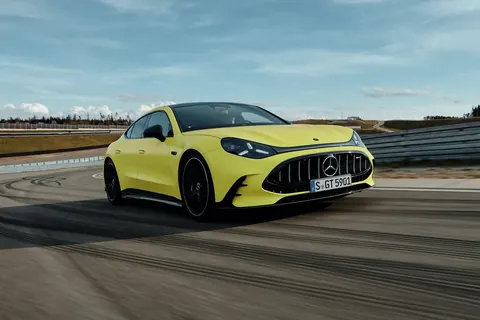
Mid-cycle refreshes are supposed to be conservative. A grille. New wheels. Maybe a software update. The 2027 7 Series is the opposite — it has been re-engineered from the dashboard outward, with Rimac-co-developed batteries under the floor, a pillar-to-pillar light projection replacing the instrument cluster, and an M Performance V8 confirmed for next year. BMW has used the G70 platform as a runway to launch the ideas that will define every luxury model from Munich over the next decade — ideas that have since turned up on the 2027 X5 (G65). Its closest new rival is no longer another petrol saloon but an EV: the Mercedes-AMG GT 4-Door Coupé EV, revealed in May 2026.
Production was set to start at Dingolfing in July 2026, and German order books opened on 28 May 2026 for the initial variants. The full lineup — including the PHEVs and the 740d — is timed for November 2026, with European deliveries through the autumn. The V8-powered M760 follows in 2027.
The 7 Series was once a car you bought because you'd arrived. The 2027 model argues you buy it because you'd like to see what arrives next.